Last Updated: May 29, 2026
Bakersfield solar rebates how they work is one of the most searched topics among Kern County homeowners right now, and for good reason. The incentive landscape has shifted dramatically since NEM 3.0 took effect, and most guides still haven’t caught up. This guide from Discount Solar breaks down every rebate, credit, and financing option available to Bakersfield residents in 2026, so you can make decisions based on accurate, current information rather than outdated assumptions.
Here’s what most guides get wrong: they treat “rebates” and “tax credits” as interchangeable. They aren’t. That single confusion causes homeowners to miscalculate their payback period by years. Below, we’ll show you exactly how each incentive works, how they stack together, and where Bakersfield’s utility landscape creates unique opportunities that state-level guides completely miss.
How Bakersfield Solar Rebates Work: The Big Picture
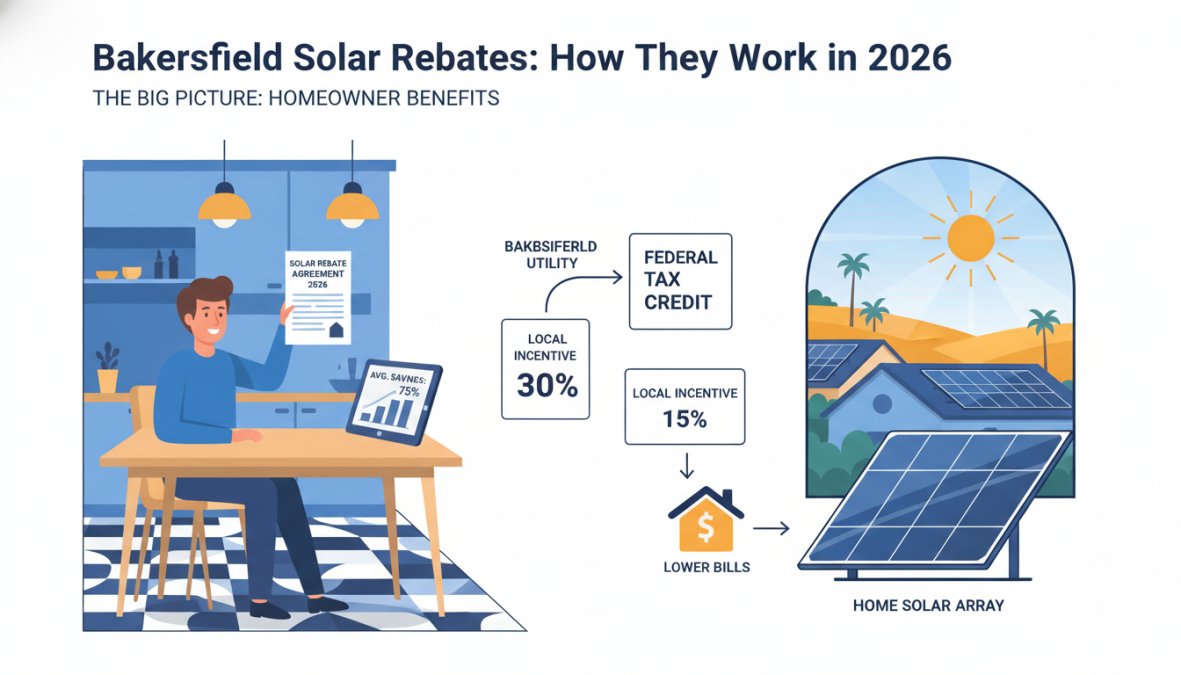
Solar incentives in Bakersfield are not a single program. They are a layered system of federal tax credits, state programs, utility-specific arrangements, and local rebates that work together to reduce the net cost of a photovoltaic system.
Understanding Bakersfield solar rebates how they work starts with recognizing that each incentive reduces your cost at a different stage. Some reduce upfront costs before installation. Others reduce your tax liability the following April. Still others reduce your ongoing utility bill for years after installation. The total savings picture only becomes clear when you account for all three layers simultaneously.
Kern County homeowners typically interact with at least four separate incentive mechanisms: the federal Investment Tax Credit (ITC), California’s Self-Generation Incentive Program (SGIP) for battery storage, net energy metering through their local utility provider, and property tax exclusions at the state level. Missing any one of these is a real financial cost.
Tax Credits vs. Rebates: A Critical Distinction
A solar tax credit is a dollar-for-dollar reduction in the income tax you owe to the federal or state government. It does not reduce your upfront installation cost. It reduces your tax bill after the system is installed, typically claimed on your annual return.
A solar rebate, by contrast, is a direct payment or bill reduction that lowers your actual out-of-pocket cost. Some rebates are paid upfront by a utility company. Others appear as credits on your utility account.
This distinction matters enormously for cash flow planning. A homeowner who expects a tax credit to cover their down payment will be disappointed. A homeowner who understands that the ITC reduces their April tax bill can plan financing accordingly. The two mechanisms are complementary, not substitutes.
Confusing tax credits with rebates is the most common financial planning mistake in residential solar. If you calculate payback period using the tax credit as an upfront discount, your estimate will be off by 12-18 months in most scenarios.
Federal Solar Tax Credit 2026: What Bakersfield Homeowners Need to Know
The federal solar tax credit 2026 rate stands at 30% of the total installed cost of a qualifying solar energy system. This includes equipment, labor, permitting fees, and battery storage when installed alongside solar panels. The credit applies directly to your federal income tax liability for the year the system is placed in service.
For Bakersfield homeowners, this is the single largest incentive available. A residential solar installation reduces federal taxes owed by 30 cents for every dollar spent on the system. The credit is non-refundable, which means it can reduce your tax liability to zero but will not generate a refund check for any excess amount. However, unused credits can roll forward to subsequent tax years.
According to the U.S. Department of Energy’s residential clean energy credit guidance, the 30% rate is scheduled to remain in place through 2032, after which it steps down to 26% in 2033 and 22% in 2034 before expiring for residential installations in 2035. Locking in the 30% rate in 2026 is a concrete financial advantage.
How to Claim the ITC: Step-by-Step
Claiming the federal Investment Tax Credit requires filing IRS Form 5695 with your annual federal tax return. The process is straightforward, but the sequence matters.
- Confirm installation year. The credit applies in the tax year the system is “placed in service,” meaning operational, not just purchased or contracted.
- Gather your final invoice. The credit is calculated on total eligible costs, including panels, inverters, mounting hardware, wiring, labor, and battery storage.
- Calculate your credit. Multiply total eligible costs by 0.30 to get your credit amount.
- Assess your tax liability. The credit cannot exceed your total federal tax liability for the year. If your liability is lower than the credit amount, the remainder carries forward.
- Complete IRS Form 5695. Enter your calculated credit on Part I of the form and carry the result to Schedule 3 of Form 1040.
- Consult a tax professional. Incentive eligibility depends on individual tax situations. A qualified CPA familiar with energy credits can confirm your specific eligibility.
Battery storage systems installed with solar in 2026 qualify for the full 30% ITC. Standalone battery systems added later may qualify under a separate provision. If you’re considering adding storage, bundling it with your initial installation captures the maximum credit in a single tax year.
Net Metering Bakersfield PG&E: Navigating the NEM 3.0 Transition
Net energy metering Bakersfield PG&E customers now operate under is NEM 3.0, which took effect for new applicants in April 2023. This is the part of the Bakersfield solar rebates conversation that most homeowners find most confusing, and the stakes are high enough that it deserves a direct, honest explanation.
NEM 3.0 fundamentally changed the economics of grid-tied solar by reducing the export compensation rate. Under the previous structure, excess kilowatt-hours sent to the grid were credited at close to the retail rate. Under NEM 3.0, export rates are lower and vary by time of day, which changes the calculus for system sizing and battery storage.
NEM 3.0 vs. NEM 2.0: What Changed and What It Means for You
The core shift is this: NEM 2.0 rewarded exporting solar energy to the grid generously. NEM 3.0 rewards consuming solar energy you generate, either in real time or through battery storage.
| Feature | NEM 2.0 | NEM 3.0 |
|---|---|---|
| Export compensation | Near retail rate | Time-of-use export rate (lower) |
| Monthly minimum charge | Standard | Higher non-bypassable charges |
| Best system design | Maximize panel output | Maximize self-consumption |
| Battery storage value | Optional | Significantly higher |
| Payback period impact | Shorter | Longer without storage |
For Bakersfield homeowners on PG&E service, the practical implication is clear: a solar-only system under NEM 3.0 produces a longer payback period than the same system would have under NEM 2.0. Adding battery storage, however, partially recovers that lost value by enabling homeowners to consume stored solar energy during peak-rate evening hours rather than exporting it at low compensation rates.
According to the California Public Utilities Commission’s NEM 3.0 decision documentation, new applicants who submitted interconnection applications before April 14, 2023 were grandfathered under NEM 2.0 for a period of 20 years. If you installed before that date, your export compensation structure is substantially more favorable.
Solar Battery Storage Rebates California: SGIP and What Kern County Homeowners Qualify For
California’s Self-Generation Incentive Program (SGIP) is the primary solar battery storage rebate available at the state level, and for Bakersfield homeowners navigating NEM 3.0, it is the single most financially impactful incentive most guides fail to explain in actionable detail. This section covers not just what SGIP is, but how the incentive tiers are structured, who qualifies for enhanced rebates, and the exact sequence of steps required to claim it, because missing the reservation window means losing the rebate entirely.
How SGIP Incentive Tiers Work
SGIP pays rebates on a per-watt-hour basis, meaning the larger your battery’s storage capacity, the larger your total rebate. The program is divided into budget groups, and within each group, incentive levels step down as the available budget is claimed. This is a first-come, first-served program with a declining incentive structure, early applicants in each budget cycle receive higher per-watt-hour rates than later applicants.
SGIP offers two primary incentive levels for residential customers:
Standard Residential Incentive: Available to all qualifying PG&E residential customers. The per-watt-hour rate varies based on available program budget at the time of reservation. Rates have historically ranged across different budget steps, and the current rate for your application window is confirmed at the time your installer submits a reservation request.
Equity Resiliency Incentive: A significantly higher incentive tier available to customers who meet one or more of the following criteria:
- Enrolled in CARE (California Alternate Rates for Energy) or FERA (Family Electric Rate Assistance) programs
- Located in a Tier 2 or Tier 3 High Fire Threat District as designated by the CPUC
- Have experienced two or more Public Safety Power Shutoff (PSPS) events
- Are a medical baseline customer
The Equity Resiliency incentive is designed to make battery storage accessible to customers most vulnerable to grid outages. For eligible Bakersfield homeowners in areas with PSPS history or fire risk designation, this tier can represent a substantially larger rebate than the standard residential rate. Confirming your eligibility for this tier before submitting a reservation is worth the extra step.
You can check your PSPS event history and High Fire Threat District designation through PG&E’s online account portal and the CPUC’s fire threat district map. If you qualify for the Equity Resiliency tier, your installer must designate this on your reservation application, it cannot be applied retroactively.
The SGIP Application Process: Step by Step
This is the part most guides omit. SGIP is not applied for after installation. The reservation must be submitted before installation begins, and the sequence is non-negotiable.
Step 1: Confirm your utility eligibility.
SGIP is administered through California’s investor-owned utilities. Bakersfield homeowners on PG&E service apply through PG&E’s SGIP program. Confirm your utility provider before proceeding.
Step 2: Select your battery system.
SGIP requires that the storage system be on the program’s approved equipment list. Your installer should confirm that the battery model you are purchasing is SGIP-eligible. Not all batteries on the market qualify.
Step 3: Your installer submits a Reservation Request.
The installer, not the homeowner, submits the SGIP Reservation Request to PG&E on your behalf before installation begins. This request locks in your incentive rate at the current budget step. Once the reservation is confirmed, your rate is protected even if the program steps down to a lower incentive level before your installation is complete.
Step 4: Installation and interconnection.
After reservation confirmation, installation proceeds. The system must be interconnected and operational before the next application step.
Step 5: Your installer submits an Incentive Claim.
After installation and interconnection, the installer submits the Incentive Claim with documentation including the final invoice, interconnection approval, and equipment specifications. PG&E reviews the claim and issues the rebate payment.
Step 6: Rebate payment.
SGIP rebates are typically paid directly to the system owner (you), not the installer, unless you have assigned the rebate to the installer as part of your contract. Confirm the payment assignment in your installation contract before signing.
If you wait until after installation to ask about SGIP, you have already missed the reservation window. The most common and most costly SGIP mistake is treating it as an afterthought. Raise it with your installer at the first consultation, not after the contract is signed.
How SGIP and the Federal ITC Stack Together
This is the financial interaction most guides ignore, and it has a meaningful impact on your net cost calculation.
The federal ITC covers 30% of the total installed cost of a battery storage system when it is installed alongside solar panels. The SGIP rebate reduces your out-of-pocket cost for the battery. These two incentives interact in a specific way:
The IRS requires that any rebate received from a utility or government program that reduces your cost basis must be subtracted from the eligible cost before calculating the ITC. In practice, this means your ITC is calculated on the net cost after the SGIP rebate, not the gross cost before it.
Simplified example of the mechanism (not a specific dollar guarantee):
- Gross battery installation cost: $X
- SGIP rebate received: $Y
- ITC-eligible cost basis: $X minus $Y
- Federal ITC (30%): 30% of ($X minus $Y)
The combined effect is still highly favorable, you receive the SGIP rebate as a direct cost reduction and the ITC as a tax credit on the remaining cost. But homeowners who calculate the ITC on the gross cost before accounting for the SGIP rebate will overestimate their tax credit. Confirm the correct cost basis calculation with your tax professional before filing Form 5695.
The Strategic Case for Storage Under NEM 3.0 in Bakersfield
Under NEM 3.0, the economic value of battery storage in Bakersfield is not theoretical, it is the primary mechanism for recovering the export compensation value that NEM 2.0 homeowners received automatically.
Under NEM 2.0, excess solar energy exported to the grid was compensated near the retail rate, so a solar-only system could generate significant bill credits. Under NEM 3.0, export rates are lower and time-of-use dependent. A solar-only system that generates excess energy during midday, when export rates are at their lowest, and then draws from the grid during the 4-9 p.m. peak window is leaving money on the table.
A battery changes this equation. Solar energy generated during low-export-rate midday hours is stored rather than exported. That stored energy is then discharged during the 4-9 p.m. peak window, displacing grid purchases at the highest rate on your PG&E bill. The value captured is the difference between the peak retail rate you avoid paying and the low export rate you would have received, a spread that, under NEM 3.0, makes storage financially meaningful rather than merely convenient.
Combined with the SGIP rebate reducing the battery’s upfront cost and the ITC covering 30% of the net installed cost, the all-in economics of solar-plus-storage in Bakersfield in 2026 are the strongest they have been since NEM 3.0 took effect.
SGIP is not a passive benefit that appears automatically. It requires a pre-installation reservation, utility-specific eligibility confirmation, and approved equipment selection. Homeowners who treat it as an afterthought forfeit a rebate that meaningfully reduces the payback period on battery storage. Ask your installer for the SGIP reservation confirmation number before installation begins.
State, Local, and Utility-Specific Solar Incentives in Bakersfield
This is the section most California solar guides skip entirely, and it is where Bakersfield homeowners lose real money by relying on state-level advice that does not apply to their specific utility account. Bakersfield’s utility landscape is not uniform. Your incentive stack, your net metering compensation rate, and even your eligibility for certain programs depend on which utility provider serves your address, and in Kern County, that answer is not always PG&E.
Who Is Your Utility Provider? It Changes Everything
The majority of Bakersfield residential customers are served by Pacific Gas and Electric (PG&E). However, portions of Kern County, including some areas in and around the city, are served by the Kern River Valley Community Services District or fall under Southern California Edison (SCE) territory depending on precise location. A small number of agricultural and rural parcels interact with smaller irrigation district providers.
This matters because:
- Net metering compensation rates differ by utility. PG&E’s NEM 3.0 export rates are set by the CPUC and follow time-of-use schedules. SCE operates under its own CPUC-approved NEM 3.0 tariff with different time-of-use windows and export values. A system designed to maximize value under PG&E’s rate structure may be sized or oriented differently than one optimized for SCE.
- SGIP eligibility is utility-specific. The Self-Generation Incentive Program is administered through California’s investor-owned utilities. PG&E customers apply through PG&E’s SGIP portal. SCE customers apply through SCE. Customers of non-IOU providers may have limited or no access to SGIP funding.
- Time-of-use peak windows differ. PG&E’s peak pricing hours under its standard residential solar tariffs (E-TOU-C and E-TOU-D) run from 4 p.m. to 9 p.m. daily. SCE’s peak windows follow a different schedule. If your battery is programmed to discharge during PG&E peak hours but your address is actually on SCE, you are optimizing for the wrong window.
Action step before anything else: Confirm your utility provider by entering your address at the CPUC’s utility territory lookup tool or by checking your current utility bill. Do not assume.
PG&E Rate Plans and Solar: E-TOU-C vs. E-TOU-D
For the majority of Bakersfield homeowners on PG&E service, the two most common residential time-of-use rate plans for solar customers are E-TOU-C and E-TOU-D. Understanding the difference is not optional, it directly determines how much your solar system saves you each month.
E-TOU-C charges a single peak rate from 4 p.m. to 9 p.m. every day, with off-peak rates at all other hours. There is no super-off-peak period. This plan rewards systems that can shift consumption or battery discharge into the 4-9 p.m. window.
E-TOU-D includes a super-off-peak period during winter months (typically 9 a.m. to 2 p.m. on weekdays in winter), which creates a lower-cost window for charging batteries from the grid during those hours. For homeowners with battery storage, E-TOU-D can enable a grid-charging strategy during super-off-peak hours that further reduces peak-hour grid purchases.
Neither plan is universally better. The right choice depends on your household’s load profile, when you use the most electricity, and whether you have battery storage. A solar-only system without storage generally performs comparably on both plans. A solar-plus-storage system can be meaningfully optimized by selecting the plan whose peak/off-peak structure aligns with your battery’s charge and discharge schedule.
When you enroll in net metering through PG&E, you will be placed on a time-of-use rate plan. Ask your installer which plan they are recommending and why. If they cannot explain the E-TOU-C vs. E-TOU-D trade-off for your specific load profile, that is a gap in their local expertise.
California Property Tax Exclusion: How It Works in Practice
California’s Active Solar Energy System property tax exclusion is established under California Revenue and Taxation Code Section 73. It prevents the assessed value of your home from increasing as a result of a qualifying solar installation. For Kern County homeowners, this exclusion is administered through the Kern County Assessor’s Office.
The practical effect: if your solar installation adds $20,000 to your home’s market value, a commonly cited figure in California real estate research, your annual property tax bill does not increase as a result of that added value. At Kern County’s general property tax rate of approximately 1%, that exclusion is worth roughly $200 per year in avoided property tax, compounding over the life of the system.
The exclusion applies automatically to new installations in most cases, but homeowners who receive a reassessment notice should confirm the exclusion has been applied by contacting the Kern County Assessor’s Office directly. The exclusion is currently authorized through at least 2026 under California law, with legislative extension possible.
Kern County Permit Costs and How They Affect Your Payback Period
Building permits are a real cost that affects your payback period, and they’re frequently underestimated in online solar cost calculators. Kern County requires building permits for all solar installations, and permit fees are calculated based on system capacity and project valuation.
Permit processing time also matters. Delays in permit approval extend the time between contract signing and system activation, which delays the start of your ITC eligibility and your first utility bill reduction. Working with an experienced local installer who understands Kern County’s permitting process reduces this risk. Discount Solar’s certified installers have navigated Kern County permitting for a decade, which means faster approvals and fewer surprises during the process.
Bakersfield’s utility landscape creates real financial differences that no state-level guide can account for. Confirming your utility provider, selecting the right PG&E time-of-use rate plan, and verifying your property tax exclusion are three steps that cost nothing but can collectively be worth thousands of dollars over a 25-year system life.

How Much Does Solar Cost in Bakersfield After Rebates?
The cost of solar in Bakersfield after incentives depends on system size, equipment selection, and which incentives you qualify for. Without fabricating specific dollar figures, the framework for calculating your net cost is consistent.
Start with your gross installation cost. Apply the 30% federal ITC to get your after-tax credit cost. Subtract any SGIP rebate if you’re adding battery storage. Factor in the ongoing utility bill reduction value over your system’s life. The result is your true net cost and payback period.
What matters most in Bakersfield’s specific context is that system sizing under NEM 3.0 should prioritize self-consumption over maximum export. Oversizing a system to export large amounts of energy to the grid at low NEM 3.0 compensation rates produces diminishing returns. A correctly sized system that covers your daytime energy consumption and charges a battery for evening use delivers better economics than a larger system without storage.
According to the National Renewable Energy Laboratory’s residential solar cost data, installed solar costs have declined significantly over the past decade, making 2026 a favorable time to install relative to historical pricing. Bakersfield’s high solar irradiance, among the highest in California, means systems here generate more energy per installed kilowatt than in most other parts of the state, which improves return on investment directly.
Solar Financing Options: PACE, HERO, and Beyond
PACE financing (Property Assessed Clean Energy) attaches the loan for your solar installation to your property rather than to you personally. Repayment happens through your property tax bill over a term of 5 to 25 years. HERO was a major PACE program in California, though it ceased originating new loans. Several other PACE programs continue to operate in Kern County.
The appeal of PACE is that it requires no money down and approval is based on home equity rather than credit score. The risk is that the obligation is tied to the property, which can complicate home sales and refinancing. Buyers of homes with PACE obligations must either pay off the balance or assume the payments.
Other financing options common in Bakersfield include:
- Solar loans: Unsecured personal loans or home equity loans used to purchase a system outright. The homeowner owns the system and claims the ITC directly.
- Solar leases: A third party owns the system and charges you a monthly fee. You do not own the system and cannot claim the ITC.
- Power Purchase Agreements (PPAs): Similar to leases, you pay for the electricity the system produces rather than buying the equipment. Again, no ITC eligibility for the homeowner.
Ownership matters for incentive eligibility. Only homeowners who purchase their system outright (cash or loan) can claim the federal ITC. Lease and PPA customers do not own the system, so the ITC goes to the financing company instead.
How Bakersfield Solar Rebates Work Together: Stacking Incentives for Maximum Savings
The full picture of Bakersfield solar rebates how they work only becomes clear when you see how the incentives stack. Each layer addresses a different cost or benefit, and they compound rather than cancel each other out.
A homeowner who purchases a solar-plus-storage system in 2026 can simultaneously access: the 30% federal ITC on the full installed cost (panels and battery), the SGIP rebate on the battery storage capacity, the California property tax exclusion on the added home value, and ongoing utility bill reduction through NEM 3.0 net metering and time-of-use optimization.
According to the Database of State Incentives for Renewables and Efficiency, California consistently ranks among the top states for total available solar incentives when federal, state, and utility programs are combined. Bakersfield homeowners benefit from this full stack.
The sequencing of applications matters. SGIP reservations must be submitted before installation. The ITC is claimed after installation on your tax return. Net metering enrollment happens through your utility at the time of interconnection. Missing the SGIP reservation window is the most common and most costly sequencing mistake.
Common Mistakes Homeowners Make When Applying for Solar Incentives
A common mistake is assuming the installer handles all incentive applications automatically. Some do. Many don’t. Confirm with your installer which applications they handle and which ones require your direct action before signing a contract.
Another frequent error is failing to confirm tax liability before relying on the ITC. The credit is non-refundable, so a homeowner with a low federal tax liability may not be able to use the full credit in year one. In that case, understanding the carryforward provision matters. The credit can roll forward to subsequent years, but this extends the effective payback timeline.
A third mistake: choosing a lease or PPA to avoid upfront costs without realizing this forfeits ITC eligibility. Over the life of the system, the tax credit foregone often exceeds the upfront cost savings. Loan financing preserves ITC eligibility while still spreading payments over time.
Signing a solar lease or PPA transfers the federal ITC to the financing company. Over a 25-year system life, the cumulative value of that forfeited credit typically exceeds the value of the zero-down convenience. Run the numbers before choosing lease over loan.
The complexity of stacking federal credits, state rebates, utility programs, and local permits is real, and getting it wrong costs Bakersfield homeowners thousands of dollars in missed savings. Discount Solar’s certified installers bring a decade of experience navigating Kern County’s specific permitting requirements, PG&E’s interconnection process, and California’s evolving incentive landscape. With a 25-year equipment warranty and custom system designs built for Bakersfield’s high-irradiance environment, Discount Solar handles the process from initial estimate through utility interconnection. Get your estimate from Discount Solar and see exactly what your net cost looks like after every available incentive is applied.
Frequently Asked Questions
Are there specific solar rebates available in Bakersfield?
Yes. Bakersfield homeowners can access several layered incentives, including the federal Investment Tax Credit (ITC), California’s Self-Generation Incentive Program (SGIP) for battery storage, and net energy metering through local utility providers like PG&E. Some Kern County municipalities may also offer additional incentives. Because these programs have eligibility requirements and application deadlines, it’s worth consulting a local solar installer to confirm which rebates apply to your specific situation before installation.
How does the federal solar tax credit work in California?
The federal Investment Tax Credit (ITC) allows eligible homeowners to deduct a percentage of their solar panel installation costs directly from their federal tax liability. As of 2026, the credit remains at 30% for qualifying residential photovoltaic systems. It’s a dollar-for-dollar reduction in what you owe the IRS, not a rebate check. If your tax liability is lower than the credit amount in year one, the unused portion can roll over to the following tax year. You must own your system outright or through a loan to qualify.
Is net metering still available for Bakersfield solar owners under NEM 3.0?
Net metering is still available in Bakersfield through PG&E, but the transition to NEM 3.0 significantly changed how exported kilowatt-hours are credited. Under NEM 3.0, export rates are lower than under NEM 2.0, which reduces the bill savings from sending excess energy back to the grid. Pairing a grid-tied solar system with battery storage is now widely recommended to maximize self-consumption and improve your return on investment under the new net metering Bakersfield PG&E framework.
Do I qualify for solar battery storage rebates in California?
California’s Self-Generation Incentive Program (SGIP) offers rebates for solar battery storage systems, and Kern County homeowners served by PG&E may be eligible. SGIP rebate amounts vary based on system capacity and applicant category, with higher incentives available to low-income households and those in high fire-risk areas. Because SGIP funds are allocated in steps and can run out, applying early is important. A certified local solar installer can help you determine your incentive eligibility and submit the application correctly.
How much can I save by installing solar panels in Bakersfield?
Savings depend on your energy consumption, system size, financing method, and which incentives you stack. After applying the 30% federal ITC and factoring in net energy metering credits, many Bakersfield homeowners see a payback period in the range of six to ten years, with utility bill savings continuing for 25 years or more. Bakersfield’s high sun exposure and above-average electricity rates make the return on investment particularly strong compared to many other California cities.