Last Updated: May 31, 2026
Finding the right storage rental of America provider takes more than a quick Google search. Most people underestimate how much the wrong choice costs them: units that are too small, facilities with poor security, or pricing that quietly increases after the first month. This guide from Discount Solar covers the full picture of what to look for, how to choose the right unit size, and how to avoid the mistakes that frustrate most first-time renters. Below, we’ll show you exactly how to evaluate storage options, understand your lease terms, and pack smarter so you get more out of every square foot.
Here’s what most guides get wrong: they focus entirely on price per square foot and ignore the factors that actually determine whether your belongings arrive intact and your experience stays hassle-free. Security technology, climate control specifications, and rate increase policies matter far more than the headline monthly rate.
What Storage Rental of America Offers
Storage rental of america facilities generally offer a broader range of unit types, lease structures, and amenity tiers than local independent operators. The category encompasses everything from bare-bones outdoor units to fully climate-controlled, interior-access facilities with 24/7 surveillance. Understanding what falls under this umbrella helps you set realistic expectations before you visit a single facility.
Self Storage Unit Types Available
Self storage units are enclosed, individually lockable spaces rented on a short- or long-term basis to individuals and businesses for storing personal property, inventory, or equipment.
The most common unit types you’ll encounter include:
- Standard indoor units: Interior-access units inside a climate-controlled building, ideal for furniture, electronics, and documents
- Drive-up units: Ground-floor units with direct vehicle access, suited for heavy items and frequent access needs
- Climate-controlled units: Maintain consistent temperature and humidity, essential for wood furniture, artwork, and sensitive materials
- Outdoor storage spaces: Open or covered lots for RVs, boats, and vehicles
- Locker units: Small, low-cost spaces for boxes, seasonal items, or overflow from a home office
The right type depends entirely on what you’re storing and how often you need to access it. A business storing archived paper files every quarter has different needs than a household mid-move who needs daily access.
Month-to-Month Leases and Flexible Terms
Month-to-month leases are the standard across most storage rental of america providers, and that flexibility is genuinely useful. You’re not locked into a 12-month commitment if your situation changes. That said, flexible leases come with a real trade-off: facilities can raise rates with relatively short notice, often 30 days, and many do exactly that after the first few months.
The practical implication: if you anticipate needing storage for six months or longer, ask the facility directly whether they offer rate-lock guarantees or promotional periods. Some storage rental of america operators provide discounted introductory rates that reset to market price after 60 or 90 days. Knowing this upfront prevents billing surprises.
Climate Controlled Storage Benefits Worth Knowing
Climate-controlled storage is the most misunderstood feature in the self storage industry. Many renters assume it’s a luxury add-on for people storing antiques. The reality is more practical: temperature and humidity fluctuations cause damage to a wider range of items than most people realize.
Wood furniture warps. Electronics corrode. Photographs yellow. Leather cracks. Cardboard boxes weaken and collapse under sustained humidity. These aren’t edge cases for collectors; they’re common outcomes for anyone storing household goods through a summer or winter season.
According to the Self Storage Association’s industry overview, climate-controlled units typically maintain temperatures between 55°F and 85°F year-round, with humidity controls that prevent the moisture spikes responsible for most material damage.
Climate-controlled storage benefits are most significant in regions with extreme seasonal temperature swings. If your facility sits in a climate where summer temperatures exceed 90°F or winter temperatures drop below freezing, climate control isn’t optional for anything you’d be upset to lose.
Ask the facility for the specific temperature range their climate control maintains, not just whether it’s “climate controlled.” Some facilities regulate temperature only, not humidity. For documents, photos, and wood furniture, humidity control is the feature that actually prevents damage.
Drive-Up Access, RV Storage, and Boat Storage
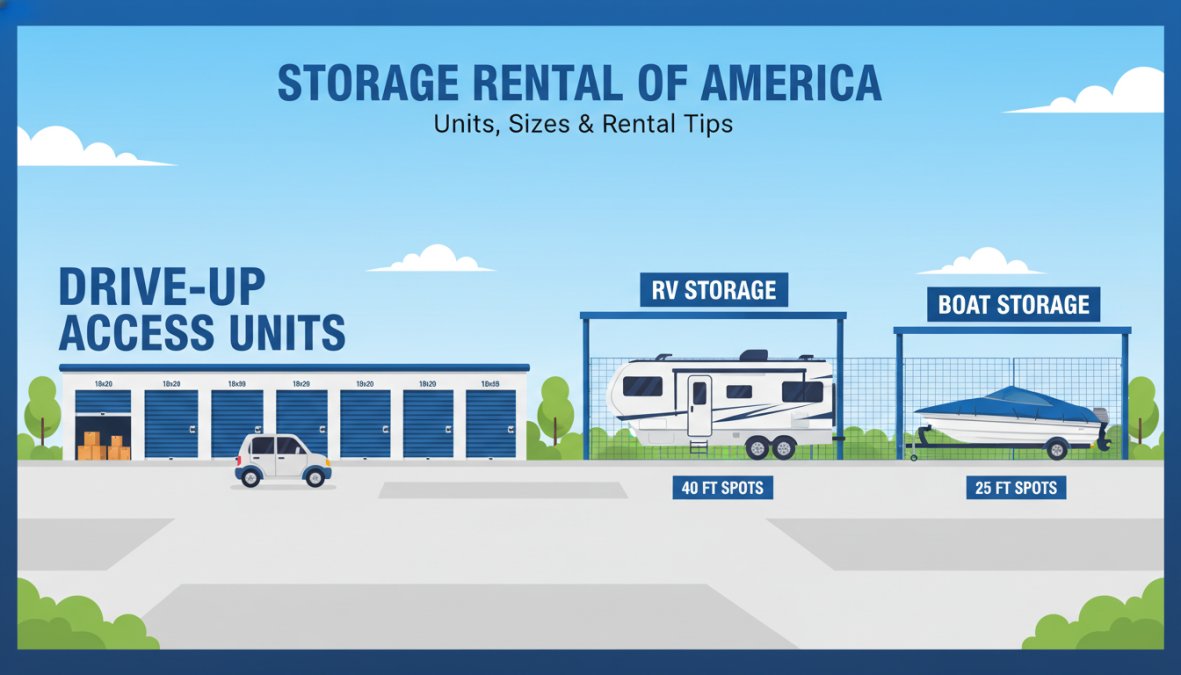
The exterior layout of a storage facility tells you a lot about who it was designed for. Drive-up access units, RV lots, and boat storage spaces require significant square footage and specific infrastructure, and not every storage rental of america location offers all three.
Drive-Up Storage Units Explained
Drive-up storage units are ground-floor units with roll-up doors that open directly to a paved drive lane, allowing renters to back a vehicle up to the door for loading and unloading without navigating hallways or elevators.
This design matters most for:
- Heavy or bulky items (appliances, furniture, construction materials)
- Business users who access their unit frequently
- Anyone without help for loading and unloading
- Contractors storing tools and equipment between job sites
The loading and unloading process is dramatically faster with drive-up access. For a household move, this can reduce the total time spent at the facility by hours. The trade-off is that drive-up units are typically not climate-controlled, because the direct exterior exposure makes temperature regulation impractical.
RV and Boat Storage at Storage Rental of America
RV storage and boat storage represent a specialized segment within the storage rental of america landscape. These spaces are typically open lots, covered carports, or enclosed garages sized for large vehicles, with pricing based on vehicle length and the level of protection offered.
A common mistake is booking an RV or boat storage space without confirming the access hours. Many facilities restrict large-vehicle access to daylight hours or require advance notice for entry. If you plan to retrieve your boat before a weekend trip, a facility with 24/7 gated access is non-negotiable.
Outdoor RV and boat storage lots expose your vehicle to UV damage, bird activity, and weather events. If you’re storing a high-value RV or boat for more than three months, enclosed or covered storage is worth the additional cost. Uncovered outdoor storage that seems like a bargain often leads to costly detailing and maintenance bills.
How to Choose a Storage Unit Size That Fits Your Needs
Choosing the wrong unit size is the single most common and most avoidable mistake in storage rental. Renting too large wastes money every month. Renting too small forces a second unit or a mid-move scramble. How to choose a storage unit size correctly comes down to inventory, not guesswork.
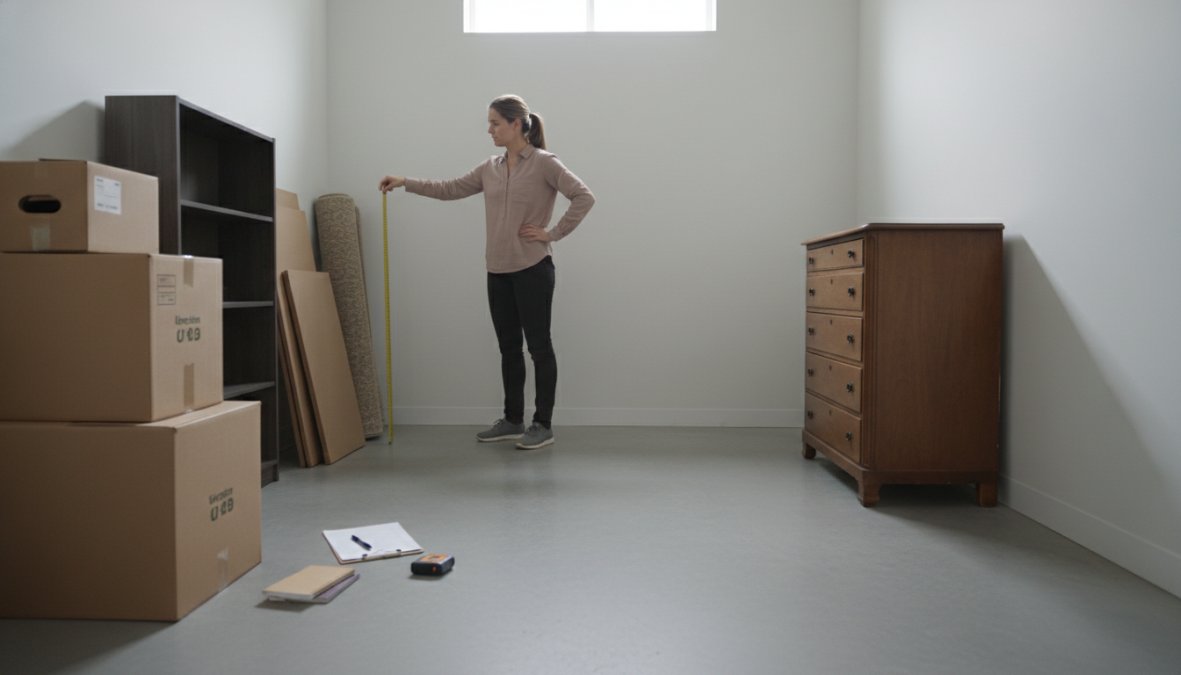
Start by listing every category of item you plan to store, then use the checklist below to match your inventory to a standard unit size.
Common Unit Size Guide and What Fits Inside
| Unit Size | Square Footage | Typical Contents | Best For |
|---|---|---|---|
| 5×5 | 25 sq ft | Small boxes, seasonal items, a few bags | Closet overflow, college storage |
| 5×10 | 50 sq ft | Studio apartment contents, mattress, small furniture | Small apartment, dorm move |
| 10×10 | 100 sq ft | 1-bedroom apartment, sofa, boxes | Standard household move |
| 10×15 | 150 sq ft | 2-bedroom apartment, appliances | Mid-size household |
| 10×20 | 200 sq ft | 3-4 bedroom home contents | Full household storage |
| 10×30 | 300 sq ft | Large home, vehicle, business inventory | Long-term or large-volume storage |
A practical sizing tip: most people underestimate by one size. If your inventory calculation points to a 10×10, book a 10×15 unless you’re confident in your packing efficiency. The cost difference is usually modest, and the alternative is a second trip to rent overflow space at full price.
The most reliable sizing method is to count your furniture pieces and large appliances first, then add box count. Furniture drives the floor space requirement; boxes fill vertical space. A unit with 8-foot ceilings and proper shelving can hold significantly more than the square footage suggests.
According to the U.S. Census Bureau’s moving and storage data, the average American moves more than 11 times in their lifetime, which means most people will use self storage multiple times. Getting the sizing decision right from the start saves real money across those moves.
Security Features and Gated Access at the Facility
Security is where the gap between marketing language and actual protection is widest. Every storage rental of america facility claims to be “secure.” What that means in practice varies enormously, and the difference between a facility that has security theater and one with genuine deterrence comes down to specific technology choices, not the presence of a camera or a fence.
This section goes deeper than the standard checklist. Below you’ll find what each security layer actually does, where each one commonly fails, and the exact questions to ask before you sign a lease.
The Five-Layer Security Stack, and Where Each Layer Breaks Down
Layer 1: Perimeter Fencing
A fully enclosed, chain-link or steel perimeter fence with a single controlled entry point is the baseline. The failure mode most facilities ignore: fence height. A standard 6-foot chain-link fence is a minor obstacle. Facilities serious about perimeter security use 8-foot fencing with anti-climb topping. Ask specifically: How tall is the perimeter fence, and does it have anti-climb features? A facility that can’t answer this question hasn’t thought carefully about its own perimeter.
Layer 2: Electronic Gate Access with Audit Logging
Personalized PIN codes or key fob access are standard. What separates a functional system from a security asset is audit logging, every entry and exit is time-stamped and tied to a specific renter’s account. This matters for two reasons: it deters renters from sharing access codes (a common source of unauthorized entry), and it gives management a verifiable record if a theft is reported.
The question to ask: Can I see a sample access log, and how long are logs retained? Facilities that retain logs for fewer than 30 days have limited ability to assist with any incident investigation.
Layer 3: CCTV Coverage, Angles and Retention Matter More Than Camera Count
A facility can have 40 cameras and still have significant blind spots. The critical positions are: the entry gate, every drive lane intersection, hallway ends on each floor, and the elevator (if present). A camera pointed at the entry gate but not at the drive lanes means a vehicle can enter legitimately and then access any unit without further recording.
Ask: Where are cameras positioned, and how many days of footage are retained? Industry practice ranges from 7 days to 90 days. For a theft that isn’t discovered immediately, which is common when renters visit infrequently, 7-day retention is effectively useless.
Layer 4: Individual Unit Door Alarms
This is the feature that most clearly separates security-serious facilities from those relying on perimeter deterrence alone. Individual door alarms are sensors mounted on each unit’s roll-up door or hasp that trigger an alert if the door is opened without a valid access event in the system. The mechanism: when a renter checks in at the gate, their unit alarm is temporarily disarmed for their session. Any door opening outside of a valid session triggers an alert to on-site management or a monitoring center.
This feature is not universal. Many facilities, including some large national operators, do not have individual unit alarms. Ask directly: Does each unit have its own door alarm, or is the alarm system perimeter-only? If the answer is perimeter-only, the only thing standing between a bad actor and your unit is the gate code.
Layer 5: Lighting, The Most Underinvested Layer
Lighting is the security feature with the highest deterrence-to-cost ratio, and it’s the one most facilities underinvest in. A well-lit facility deters opportunistic access far more effectively than a camera system that records incidents after the fact. The specific standard worth asking about: motion-activated LED lighting in drive lanes and hallways, with baseline ambient lighting that keeps the property visible from the perimeter road at all times.
Visit any facility you’re seriously considering after dark, not just during business hours. The difference between a facility’s daytime appearance and its nighttime lighting conditions is often significant. A dark perimeter road and unlit drive lanes are a reliable signal that security investment stopped at the marketing brochure.
When you visit a facility in person, ask to see the monitoring station or the manager’s office screen. Facilities with active CCTV monitoring will have a live feed visible. If the cameras are installed but no one is watching the feed, the system functions as a forensic tool after an incident, not a deterrent before one.
On-Site Management: The Human Layer
A staffed office during business hours adds a deterrence layer that technology alone cannot replicate. On-site managers notice unfamiliar vehicles, observe unusual behavior, and can respond to alarms in real time. The question worth asking: What are the staffed hours, and is there a monitoring service for after-hours alerts?
Facilities that are fully unstaffed outside of business hours rely entirely on their technology stack and a third-party alarm monitoring service. That’s not necessarily a disqualifier, but it means the response time to any after-hours incident depends on a monitoring center’s call queue and local law enforcement availability, not an on-site person.
The Pre-Lease Security Verification Checklist
Before signing any lease at a storage rental of america facility, ask these questions and note whether the answers are specific or evasive:
- What is the height and material of the perimeter fence?
- Does gate access generate an individual audit log per renter?
- How many days of CCTV footage are retained, and where are cameras positioned?
- Does each unit have an individual door alarm, or is the alarm system perimeter-only?
- What are the staffed hours, and who monitors alarms after hours?
- When was the security system last upgraded or audited?
Evasive or vague answers to any of these questions are a meaningful signal. A facility confident in its security infrastructure can answer all six without hesitation.
Do not rely on a facility’s website security page as your verification. Marketing language like “state-of-the-art security” and “fully monitored” is not standardized and carries no enforceable meaning. The only reliable verification is asking specific questions in person and observing the facility yourself.
Easy Online Rentals, Reservations, and Online Payment
The shift toward fully online rental has genuinely improved the storage experience, but the process has more steps, decision points, and potential friction than most facility websites acknowledge. This section walks through the complete online rental flow for storage rental of america providers, flags the steps where most renters make avoidable mistakes, and explains how to use the reservation system strategically when you’re comparing multiple facilities.
How the Online Rental Process Actually Works, Step by Step
Most storage rental of america operators now support a complete online rental flow. Here’s what that process looks like in practice, and where each step requires your attention:
Step 1: Unit Search and Availability Check
Enter your zip code or city on the facility’s website or a third-party aggregator. Filter by unit size, unit type (climate-controlled, drive-up, indoor), and price range. The listed price at this stage is almost always the promotional rate, the discounted introductory price, not the ongoing market rate. Note both figures before proceeding. If only one price is shown, ask for the standard rate before reserving.
Step 2: Online Reservation (Hold Without Commitment)
This is the step most renters skip or misunderstand. An online reservation holds a specific unit at the listed price for a defined window, typically 24 to 48 hours, without requiring payment or a signed lease. You are not committed. The facility cannot rent that unit to someone else during the hold period.
The strategic use of reservations: if you’re comparing two or three facilities, place reservations at all of them simultaneously. This locks in current pricing at each location while you complete your comparison. When you’ve made your decision, sign the lease at your chosen facility and let the other reservations expire. No penalty, no obligation.
Step 3: Digital Lease Signing
The lease document is the most important step and the one renters spend the least time on. Before signing, locate and read these specific clauses:
- Rate increase notice period: How many days of advance notice are required before a rate change takes effect? Thirty days is common; some operators provide 60.
- Promotional rate expiration: If you’re receiving an introductory rate, what is the exact date it expires and what does the rate revert to?
- Late fee structure: What is the fee amount and how many days past due before it triggers?
- Lien and auction policy: After how many days of non-payment can the facility place a lien on your belongings? State law governs this, but the timeline varies.
- Insurance requirement: Most facilities require proof of insurance or offer their own coverage add-on. Understand what is and isn’t covered before declining.
If the digital lease is presented as a click-through with no option to download a copy before signing, ask for a PDF via email before completing the process. You are entitled to a copy of any lease you sign, and having it on file prevents disputes about what terms you agreed to.
Step 4: Access Code Delivery
After signing and making your first payment, most facilities deliver your gate access code and unit number via email or through a mobile app. Some operators use a proprietary app that also allows you to open the gate remotely, view your payment history, and submit maintenance requests. If the facility uses an app, download it before your first visit, troubleshooting access issues in a parking lot is avoidable.
Confirm before your first visit: Is my access code active, and what are the access hours? Some facilities have gate hours that differ from office hours. A code that works during business hours only is a significant inconvenience if you plan to access your unit early morning or on weekends.
Step 5: Auto-Pay Setup
Late fees at storage facilities accumulate quickly, commonly in the range of $15 to $25 per occurrence, with some operators charging a percentage of the monthly rent after a defined grace period. Setting up auto-pay at the time of lease signing eliminates this risk entirely. Most online portals support ACH bank transfer (typically free) or credit card (sometimes with a processing fee of 2 to 3 percent). Use ACH if avoiding the processing fee matters to your budget.
One important note on auto-pay: enabling auto-pay does not protect you from rate increases. Your account will be charged the new rate automatically after the notice period expires. Set a calendar reminder to review your storage bill monthly, particularly in the first six months when introductory rate expirations are most common.
Third-Party Aggregators vs. Booking Directly
Sites that aggregate storage listings across multiple operators can be useful for initial price comparison, but they introduce one consistent complication: the unit you see on an aggregator may not reflect real-time availability at the facility. Prices shown on aggregator platforms are sometimes promotional rates negotiated between the platform and the operator, and may differ from what the facility quotes if you call directly.
For initial comparison: aggregators are efficient. For final booking: go directly to the facility’s own website or call the location. This ensures you’re seeing current availability, the actual lease terms, and any facility-specific promotions that aren’t listed on third-party platforms.
What Online Rental Cannot Replace
Fully online rental is convenient, but it has one genuine limitation: you cannot assess the actual facility condition, lighting quality, access road width, or elevator functionality from a website. For storage commitments of two months or longer, a brief in-person visit before signing is worth the time.
Specifically, visit to verify:
- The drive lane width (critical if you’re using a moving truck or large vehicle)
- The elevator size and reliability (for multi-story indoor facilities)
- The actual lighting conditions in the drive lanes and hallways
- Whether the facility matches the photos on the website
The online rental process is genuinely fast and functional at most storage rental of america operators, but the lease document deserves more attention than most renters give it. The five minutes spent reading the rate increase clause, promotional expiration date, and lien policy before signing will save more frustration than any other single step in the rental process.
Storage Unit Rental Tips: Packing, Pricing, and Avoiding Mistakes
The difference between a storage unit that works for you and one that becomes a frustrating monthly expense usually comes down to how well you packed it and whether you understood the pricing structure before signing. These storage unit rental tips address both.
Packing Hacks to Maximize Your Storage Space
Most people pack a storage unit the way they’d pack a moving truck: furniture against the walls, boxes stacked in the middle, large items wherever they fit. This approach wastes 30 to 40 percent of the available vertical space and makes accessing anything in the back nearly impossible.
A better approach:
- Disassemble furniture before loading. Bed frames, shelving units, and tables take a fraction of the space when broken down and stored flat.
- Use uniform box sizes. Consistent box dimensions stack cleanly and stably to ceiling height. Irregular boxes create unstable towers that collapse.
- Label every box on the side, not the top. Once boxes are stacked, top labels are invisible. Side labels let you identify contents without moving anything.
- Create an access aisle. Leave a 24-inch path down the center of the unit to reach items stored in the back. Skipping this step means unloading half the unit every time you need something.
- Store frequently accessed items near the front. Seasonal decorations go in the back; items you might need monthly stay within arm’s reach.
- Use vertical space with shelving. Freestanding metal shelving units are inexpensive and transform a 10×10 unit’s effective capacity.
Understanding Rate Increases and Transparent Pricing
Rate increases are the most common complaint across storage rental of america reviews, and they’re almost always avoidable with better upfront questions. The standard practice at many facilities is to offer a below-market introductory rate for the first two to three months, then adjust to market rate with 30 days’ notice.
This isn’t inherently deceptive, but it catches renters off guard when they haven’t asked the right questions. Before signing any lease, ask:
- What is the current market rate for this unit, separate from any promotion?
- How often have rates increased in the past 12 months?
- Is there a maximum percentage rate increase per year?
- What notice will I receive before any rate change?
Transparent pricing means the facility can answer all four questions clearly. Evasive answers to any of them are a signal to look elsewhere. According to the Better Business Bureau’s storage industry complaint data, unexpected rate increases are among the top three complaints filed against storage facilities nationally. Asking these questions before signing eliminates the surprise entirely.
Finding reliable, affordable storage takes real research, and the pricing and security details that matter most are rarely front and center on a facility’s website. If you’re in the middle of a move, a home renovation, or a downsizing project and need to make a fast decision, focus on three things: verify the security infrastructure in person, ask about rate increase history directly, and choose a unit size one step larger than your initial estimate. Discount Solar publishes practical guides like this one to help homeowners in Kern County make smarter decisions about their homes and properties. If reducing your monthly energy costs is the next item on your list, our certified installers offer custom solar solutions backed by a 25-year equipment warranty. Get an estimate from Discount Solar and start redirecting what you spend on electricity toward what actually matters.
Frequently Asked Questions
Is Storage Rental of America a reputable company?
Storage Rental of America is generally regarded as a reliable self storage provider with facilities across multiple locations. They offer features like gated access, online rental options, and flexible month-to-month leases. As with any storage facility, it is advisable to read recent customer reviews for the specific location you plan to use, verify security features in person, and confirm pricing terms before signing your rental agreement.
What types of storage units does Storage Rental of America offer?
Storage Rental of America typically offers a range of unit types including standard indoor units, climate-controlled storage units, drive-up access units for easy loading and unloading, and outdoor spaces for RV storage and boat storage. Unit sizes generally range from small 5×5 spaces suitable for boxes and small items up to large 10×30 units that can hold the contents of a multi-bedroom home.
Does Storage Rental of America offer climate-controlled units, and who needs them?
Yes, many Storage Rental of America locations offer climate-controlled storage units. These are ideal for items sensitive to temperature and humidity swings, such as wooden furniture, electronics, artwork, documents, clothing, and musical instruments. Climate-controlled storage benefits include reduced risk of warping, mold, and rust. If you are storing valuables long-term or live in a region with extreme seasonal temperatures, a climate-controlled unit is strongly recommended.
Can I rent a storage unit online with Storage Rental of America, and what are the lease terms?
Most Storage Rental of America facilities allow you to complete an online rental or reservation through their website, making it easy to secure a unit without visiting in person. Lease terms are typically month-to-month, giving you flexible storage solutions without a long-term commitment. Online payment options are also generally available, so you can manage your account, pay your bill, and update your reservation from any device at any time.
How do I choose the right storage unit size to avoid overpaying?
Start by listing every item you plan to store and grouping them by size. A 5×5 unit fits a few boxes and small furniture. A 10×10 handles a one-bedroom apartment’s worth of belongings. A 10×20 or larger suits a full house move or vehicle storage. Many storage facilities offer a size guide or online calculator to help. When in doubt, choose one size up, it is more affordable than renting a second unit later and gives you room to stack efficiently.