Last Updated: May 26, 2026
Understanding how solar panels work at home is more straightforward than most people expect, yet the details matter enormously when you’re making a decision that affects your electricity bills for decades. This guide from Discount Solar breaks down the full process, from photons hitting silicon cells to kilowatt-hours appearing on your meter, so you can make a confident, informed choice. Below, we’ll cover every major component, explain the real differences between inverter types, and show you exactly what happens to the excess energy your system generates. Most guides stop at “sunlight becomes electricity.” This one goes further.
Here’s what most introductions get wrong: they treat solar as simple. The photovoltaic effect, inverter selection, battery integration, and net metering rules all interact in ways that can mean the difference between a system that pays for itself in eight years and one that takes fifteen. The fundamentals are accessible. The nuances are where homeowners leave money on the table.
How Solar Panels Work at Home: The Big Picture
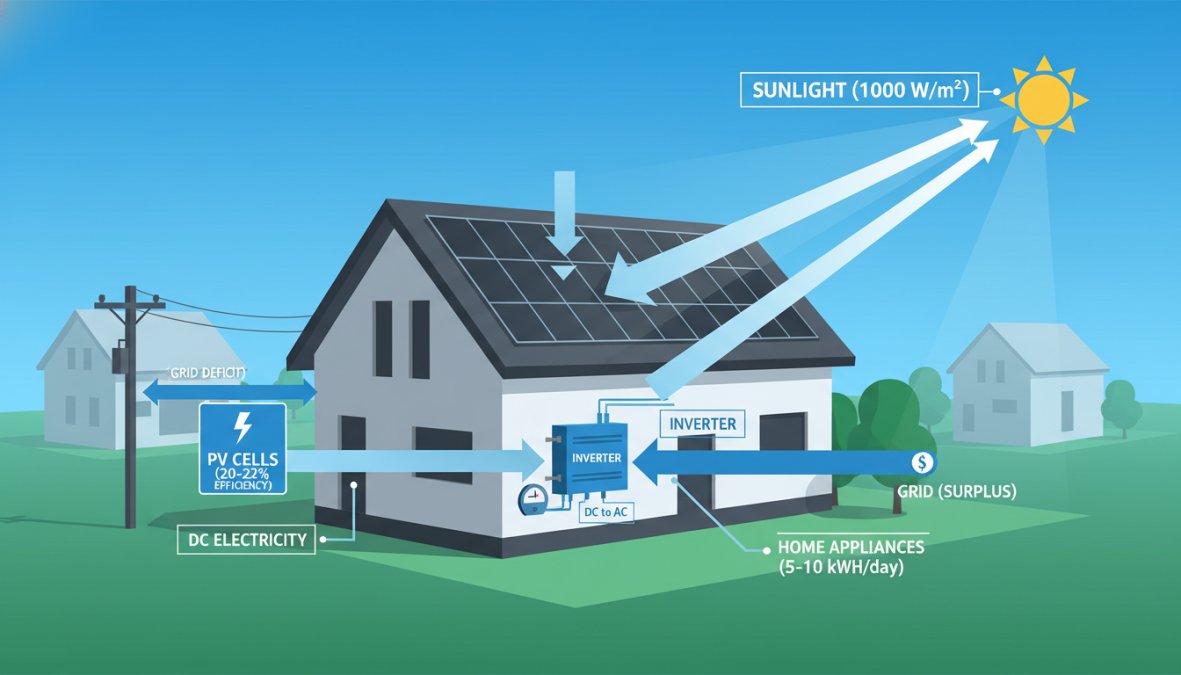
A home solar energy system converts sunlight into usable electricity through a chain of components, each with a specific role. Solar panels capture photons from sunlight and generate direct current (DC) electricity. An inverter converts that DC current into alternating current (AC power), which your home’s appliances actually use. Any excess electricity either flows to the grid, charges a solar battery, or both.
The system connects to your utility company’s grid through a meter, which tracks both consumption and any electricity you send back. That bidirectional relationship is the foundation of net metering, and it’s what makes residential solar financially viable for most homeowners.
According to the U.S. Department of Energy’s Office of Energy Efficiency and Renewable Energy, residential solar installations have grown substantially year over year as panel costs have dropped and efficiency ratings have improved. The trajectory is clear: solar is no longer a niche technology for early adopters.
The throughline of this guide is practical clarity. Understanding each component helps you ask better questions of your installer, avoid common sizing mistakes, and set realistic expectations for energy independence.
Key Components of a Home Solar Energy System
A complete residential solar installation includes several interdependent parts:
- Solar panels (PV modules): The panels themselves, typically mounted on the roof at an angle optimized for your latitude
- Inverter: Converts DC current from panels into AC current for household use
- Racking and mounting hardware: Secures panels to the roof structure
- Conduit and wiring: Carries electrical current between components
- Meter: Measures energy production and consumption bidirectionally
- Solar battery (optional): Stores excess electricity for use during evenings or outages
- Charge controller (for off-grid systems): Regulates voltage and current to protect batteries
Each component affects system performance. Undersizing the inverter relative to your solar array, for example, creates a bottleneck that limits total output regardless of how many panels you install.
Ask your installer for a one-line electrical diagram before signing any contract. This document shows exactly how every component connects and makes it easy to verify sizing decisions are appropriate for your home’s energy load.
The Photovoltaic Effect Explained: How Sunlight Becomes Electricity
The photovoltaic effect is the physical process by which certain semiconductor materials generate an electric current when exposed to light. In practical terms, photons from sunlight strike silicon atoms inside a PV cell, knocking electrons loose and creating a flow of electric charge.
Each solar cell contains two layers of silicon: one doped with phosphorus (n-type, carrying extra electrons) and one doped with boron (p-type, carrying “holes” where electrons are missing). The boundary between these layers creates an electric field. When photons dislodge electrons at this junction, the electric field pushes them in one direction, producing DC current. Multiple cells wired together form a panel; multiple panels wired together form a solar array.
The elegance of the photovoltaic effect is that there are no moving parts, no combustion, and no greenhouse gas emissions during operation. The system degrades slowly over time, which is why quality equipment warranties matter significantly.
Monocrystalline, Polycrystalline, and Thin-Film: Which PV Cell Type Is Best?
The three main PV cell technologies differ in manufacturing process, efficiency, and cost. Choosing the right type depends on your roof space, budget, and performance priorities.
| Cell Type | Efficiency Range | Best For | Key Trade-off |
|---|---|---|---|
| Monocrystalline | 18-22%+ | Limited roof space | Higher upfront cost |
| Polycrystalline | 15-17% | Larger roofs, tighter budgets | Lower efficiency per panel |
| Thin-film | 10-13% | Commercial, flexible surfaces | Requires more space |
Monocrystalline panels are cut from a single silicon crystal, producing the highest efficiency and a uniform black appearance. They perform better in low-light conditions and high temperatures than polycrystalline alternatives.
Polycrystalline panels are made from multiple silicon fragments melted together. They carry a lower price per panel but require more roof area to generate equivalent power output.
Thin-film panels deposit photovoltaic material onto glass, plastic, or metal. They’re lightweight and flexible but rarely the right choice for residential rooftop installations given their lower efficiency.
For most homeowners with standard roof space, monocrystalline panels deliver the best long-term value. The efficiency gap over polycrystalline is meaningful when roof area is limited.
Solar Inverter Function: Converting DC Current to Usable AC Power
The inverter is the brain of your solar energy system. Its job is converting DC current from your panels into the 120/240V AC power that every appliance, outlet, and light fixture in your home requires. Inverter selection affects system efficiency, monitoring capability, and how well individual panels perform when one is shaded or underperforming.
String Inverters vs. Microinverters vs. Hybrid Inverters
This is the part most homeowners don’t dig into deeply enough, and it’s where real performance differences emerge.
String inverters connect all panels in a series “string” to a single central inverter. They’re the most cost-effective option and work well on roofs with consistent, unobstructed sun exposure. The significant limitation: if one panel in the string underperforms due to shade, bird droppings, or debris, it drags down the output of every other panel on that string. Think of it like old-style Christmas lights.
Microinverters attach to each individual panel, converting DC to AC right at the source. Each panel operates independently, so shading on one panel has zero effect on the rest of the array. Microinverters also provide panel-level monitoring, making it easy to identify underperforming units. The trade-off is higher upfront cost and more components on the roof.
Hybrid inverters (also called multi-mode inverters) handle both solar panel input and battery storage in a single unit. They’re the smart choice for homeowners planning to add a solar battery now or in the future, since they eliminate the need for a separate battery inverter later.
For roofs with partial shading from trees, chimneys, or neighboring structures, microinverters or DC optimizers will consistently outperform string inverters. The efficiency gain over a 25-year system life often justifies the cost difference.
Solar Panel Efficiency Factors Every Homeowner Should Know
Solar panel efficiency is the percentage of sunlight hitting the panel surface that gets converted into usable electricity. A panel rated at 20% efficiency converts one-fifth of incoming solar energy into power. Higher efficiency means more electricity from the same roof area.
Several real-world factors affect how efficiently your system performs:
Temperature: Counterintuitively, solar panels lose efficiency as temperature rises. Most panels are rated at 25°C (77°F), and output decreases above that threshold. In hot climates like Kern County, California, this is worth factoring into system design.
Roof orientation and tilt: South-facing roofs at an angle matching your geographic latitude capture the most sunlight annually. East and west-facing installations still work well but typically produce less than an optimally oriented south-facing array.
Shading: Even partial shading on a small section of a panel can reduce output significantly, particularly in string inverter configurations.
Panel age and degradation: Quality solar panels degrade at roughly 0.5% per year under normal conditions, meaning a panel producing 400W today will produce around 390W a decade from now. This is why a 25-year equipment warranty, like the one offered by Discount Solar, matters for long-term performance guarantees.
Soiling and maintenance: Dust, pollen, and bird droppings reduce light transmission. In most climates, rainfall handles most cleaning naturally, but periodic inspection catches buildup that rain doesn’t address.
According to NREL’s PV Performance Modeling resources, system design choices, including tilt, azimuth, and component selection, can meaningfully affect annual energy yield even for identically sized systems.
Solar Battery Storage for Homes: How Excess Energy Gets Saved
Solar battery storage for homes solves the fundamental timing mismatch in residential solar: panels generate the most electricity midday, while household energy demand peaks in the morning and evening. A solar battery captures surplus daytime generation and releases it when the sun isn’t shining.
Most residential battery systems use lithium-ion chemistry, the same technology in electric vehicles. They connect to the inverter and can be configured to prioritize self-consumption, backup power, or grid export depending on your utility’s net metering rates and your household’s priorities.
A charge controller regulates the flow of electricity into the battery, preventing overcharging and protecting battery lifespan. In grid-tied systems with batteries, the hybrid inverter typically handles this function.

Grid-Tied, Off-Grid, and Hybrid Solar Systems Compared
Grid-tied systems connect directly to the utility grid with no battery storage. They’re the most common and cost-effective residential configuration. When your panels produce more than you use, excess electricity flows to the grid, and your utility credits you through net metering. The limitation: during a grid outage, a standard grid-tied system shuts down automatically for safety reasons, leaving you without power even if the sun is shining.
Off-grid solar systems operate entirely independently of the utility grid. They require significantly larger battery banks and often a backup generator for extended low-sunlight periods. Off-grid systems are most practical for rural properties where grid connection is expensive or unavailable.
Hybrid systems combine grid connection with battery storage. They provide backup power during outages, allow homeowners to maximize self-consumption, and offer the flexibility to sell stored energy back to the grid during peak rate periods. For most suburban homeowners, a hybrid system represents the best balance of resilience and cost.
Grid-tied systems without battery backup will not power your home during a utility outage, even on a sunny day. If backup power is a priority, confirm your inverter and system configuration explicitly support it before installation.
How Solar Panels Work With the Grid: Net Metering and Your Utility Company
Net metering is the billing arrangement that makes residential solar financially practical for grid-tied homeowners. Under net metering, your utility company measures the difference between the electricity your solar array sends to the grid and the electricity you draw from it. When your panels produce more than you consume, the surplus flows out through your meter, and you receive a credit on your bill.
The credit rate varies by utility and state policy. Some utilities offer full retail rate credits; others offer a lower avoided-cost rate. Understanding your local net metering policy before sizing your system is critical because it directly affects your return on investment.
Net metering works through a bidirectional meter that your utility installs, replacing your standard consumption-only meter. Your installer coordinates this process with the utility company as part of the interconnection agreement, which is a formal approval process required before your system can operate.
As the Solar Energy Industries Association’s net metering resources document, net metering policies vary significantly by state and are subject to legislative and regulatory changes. Locking in current policy terms through timely installation can protect your financial projections.
Solar Costs, Incentives, and What It Really Saves Homeowners
The upfront cost of a residential solar installation depends on system size, panel type, inverter choice, and local labor rates. Larger systems cost more in absolute terms but often deliver better cost-per-watt economics. The right system size is determined by your annual kilowatt-hour consumption, not by a round number.
Ongoing costs are minimal. Solar panels have no moving parts and require little maintenance. The inverter is the component most likely to need replacement over a 25-year system life.
Federal Solar Tax Credit, Solar Loans, and PPAs
Federal Solar Tax Credit (Investment Tax Credit): Homeowners who purchase and install a solar energy system can claim a federal tax credit equal to a percentage of the total system cost. This credit applies to panels, inverters, batteries, and installation labor. Consult a tax professional to confirm eligibility based on your specific tax situation.
Solar loans: Many homeowners finance their system through a solar loan, which allows immediate ownership and full access to tax incentives. Monthly loan payments are often lower than the electricity bill savings the system generates, creating positive cash flow from day one.
Power Purchase Agreements (PPAs): Under a PPA, a solar provider installs panels on your roof at no upfront cost, and you agree to purchase the electricity generated at a fixed rate below your utility’s retail rate. You don’t own the panels, which means you don’t receive tax incentives, but you also have no maintenance responsibility and no capital outlay.
The right financing structure depends on your tax liability, available capital, and long-term plans for the property. Homeowners who can use the federal tax credit and plan to stay in their home long-term typically benefit most from ownership.
Home property value increases associated with solar installations are generally not subject to property tax reassessment in California under the active solar energy system exclusion. Verify current rules with your county assessor before installation.
Environmental Impact, Maintenance, and End-of-Life Considerations
The environmental case for residential solar is strong, but it deserves honest treatment rather than marketing language. Solar panels do have a manufacturing footprint: producing silicon PV cells requires energy and materials. The carbon payback period, the time it takes for a panel to generate as much clean energy as was used to manufacture it, typically ranges from one to four years depending on panel type and regional energy mix. Over a 25-30 year lifespan, the net reduction in greenhouse gas emissions is substantial.
Maintenance requirements for a well-installed solar array are genuinely low. Panels should be inspected annually for physical damage, soiling, and connection integrity. Inverters have monitoring systems that flag performance drops, making it straightforward to identify issues before they compound. Most certified installers include a maintenance check in their post-installation service.
End-of-life panel management is an evolving area. Thin-film panels may contain small amounts of cadmium or other materials requiring specialized recycling. Silicon-based monocrystalline and polycrystalline panels are largely composed of glass, aluminum, and silicon, making them more straightforward to recycle. Several manufacturers and third-party programs now offer panel take-back and recycling services, and regulatory frameworks governing solar panel recycling are developing in multiple states.
The honest position: solar is one of the lowest-lifecycle-impact electricity sources available to homeowners today, but responsible end-of-life planning is part of a complete sustainability picture. As noted by the International Renewable Energy Agency’s lifecycle analysis resources, the full environmental benefit of solar is realized over the complete system lifetime, not just at the point of installation.
Conclusion: Is a Home Solar Installation Right for You?
Electricity costs in Kern County continue to rise, and homeowners face a straightforward question: keep paying retail utility rates indefinitely, or invest in a system that generates power for decades. Discount Solar brings ten years of installation experience and a 25-year equipment warranty to every project, with certified installers who design custom solar solutions matched to your actual energy consumption and roof configuration. Flexible financing options make ownership accessible without requiring significant upfront capital. Get your estimate from Discount Solar and see exactly what your home’s solar potential looks like.
Frequently Asked Questions
How do solar panels convert sunlight into electricity at home?
Solar panels use photovoltaic (PV) cells made from semiconductor materials, typically silicon, to convert sunlight into electricity. When photons from sunlight strike the PV cells, they knock electrons loose, creating an electric field that drives DC current through the circuit. That DC current travels to an inverter, which converts it to AC current your home can use. Understanding how solar panels work at home starts with this photovoltaic effect, it’s the core of every residential solar energy system.
What factors affect solar panel efficiency in a home system?
Several solar panel efficiency factors influence how much electricity your system produces. These include panel type (monocrystalline panels are generally the most efficient), roof orientation and tilt angle, shading from trees or nearby structures, local climate and temperature, and the age of the panels. Dirt and debris accumulation can also reduce output. In sunny regions like Bakersfield, CA, homeowners typically see strong year-round performance due to high sunlight exposure, making efficiency optimization especially rewarding.
Do solar panels work on cloudy days or at night?
Solar panels do produce electricity on cloudy days, though output is reduced compared to full sunlight, typically by 10-25% depending on cloud density. At night, PV cells cannot generate power because there are no photons to activate the electric field. Homeowners address this with solar battery storage for homes, which stores excess energy produced during the day for nighttime use, or through net metering, where surplus daytime energy is sent to the grid in exchange for credits on energy bills.
What is the difference between string inverters, microinverters, and hybrid inverters?
String inverters connect all panels in a series and convert DC current to AC current at one central unit, they’re cost-effective but can underperform if one panel is shaded. Microinverters attach to each individual panel, optimizing output per panel and improving performance in partial-shade conditions, though at a higher upfront cost. Hybrid inverters combine solar inverter function with battery management, making them ideal for homeowners who want solar battery storage for homes alongside grid connectivity. Your best choice depends on roof layout, budget, and energy goals.
What financial incentives are available for home solar installation?
Homeowners can take advantage of several solar incentives to reduce the cost of a solar installation. The federal solar tax credit currently allows you to deduct a significant percentage of your system cost from federal taxes. Many states and utility companies offer additional rebates or net metering programs that credit you for excess kilowatt-hours sent to the grid. Financing options like solar loans and power purchase agreements (PPAs) can also make going solar more accessible, often with little or no money down.
How does net metering work and how does it affect my energy bills?
Net metering allows homeowners with a grid-tied solar array to send surplus electricity back to the utility company in exchange for credits on their energy bills. When your solar panels produce more power than your home uses, common on sunny afternoons, the excess flows through your meter to the grid. At night or on low-production days, you draw from the grid and those credits offset what you owe. Over a full year, net metering can significantly reduce or even eliminate your electricity costs depending on system size and local utility policies.