Last Updated: June 01, 2026
Bakersfield summers are brutal by any measure, and your HVAC system bears the full weight of that reality. For anyone searching for HVAC Bakersfield, CA services, the stakes are higher here than in most California cities: triple-digit temperatures, persistent dust from the San Joaquin Valley floor, and a heating and cooling season that stretches far longer than the national average. This guide from Discount Solar covers everything you need to know about local HVAC services, from what repairs actually cost to how to spot a contractor who will take advantage of you. Below, we’ll show you exactly how to evaluate companies, troubleshoot common problems yourself, and claim energy rebates most Bakersfield homeowners never touch.
Here’s what most guides get wrong: they treat HVAC advice as universal. It isn’t. A system designed for coastal San Diego will fail early in Kern County. The climate conditions here demand specific equipment choices, maintenance schedules, and installation standards that generic guides simply don’t address.
Why HVAC in Bakersfield CA Is Different From Anywhere Else
HVAC in Bakersfield CA operates under conditions that push residential and commercial systems harder than almost anywhere else in the state. The combination of extreme heat, agricultural dust, and wide temperature swings creates a unique stress profile for any heating and cooling equipment. Understanding this is the first step toward making smarter decisions about your system.
Bakersfield’s Climate Challenges: Extreme Heat and Dusty Air
Summer temperatures in Bakersfield regularly exceed 100°F for weeks at a stretch. That sustained load forces air conditioning systems to run near maximum capacity for extended periods, which accelerates wear on compressors, capacitors, and fan motors faster than manufacturers’ standard estimates account for.
The dust problem is equally serious. Kern County sits in an agricultural basin where particulate matter is a year-round issue. Filters clog faster here than in coastal or mountain communities. A filter that lasts 90 days in Sacramento might need replacement every 30 days in Bakersfield. Dirty filters don’t just reduce air quality: they restrict airflow, force the system to work harder, and drive up energy bills. According to U.S. Department of Energy guidance on HVAC maintenance, a clogged filter is one of the most common causes of preventable system failure.
The winter side of the equation surprises many newer residents. Temperatures can drop into the low 30s overnight from December through February, meaning your furnace service requirements are genuine, not theoretical.
Running your AC system without a clean filter in Bakersfield’s dusty conditions can reduce system efficiency significantly and void manufacturer warranties. Check filters monthly, not quarterly.
How the Central Valley’s Conditions Affect Your System’s Lifespan
The average HVAC system lifespan is typically cited at 15-20 years under normal conditions. In the Central Valley, many homeowners and technicians report systems aging faster due to the sustained heat load and particulate exposure. Ductwork is particularly vulnerable: dust infiltration into poorly sealed ducts degrades indoor air quality and forces the system to compensate for lost airflow.
Heat pumps face a specific challenge here. They’re efficient across a wide temperature range, but extreme summer peaks can push them outside their optimal operating window. If you’re considering a heat pump installation, a certified technician should assess whether your specific home’s load calculations support one for Bakersfield conditions.
HVAC Services Offered: Residential and Commercial Coverage
The range of HVAC Bakersfield, CA services available spans everything from a single-room repair to full mechanical system design for large commercial buildings. Knowing what category your need falls into helps you find the right contractor and avoid paying commercial rates for a residential job.
Residential HVAC: Installations, Replacements, and Repairs
Residential HVAC covers the full cycle of a home comfort system. Most homeowners interact with HVAC services in one of three scenarios: something breaks and needs repair, a system is aging and needs replacement, or a new home needs a full installation.
HVAC installation for a new or replacement system is a significant project. A licensed contractor will perform a Manual J load calculation to determine the correct system size for your home’s square footage, insulation levels, and window exposure. Oversized systems short-cycle, which wastes energy and causes humidity problems. Undersized systems run constantly and still fail to cool adequately during peak Bakersfield heat. Neither outcome is acceptable.
Residential services typically include:
- Central AC repair and replacement
- Furnace service and replacement
- Heat pump installation and maintenance
- Thermostat upgrades and smart thermostat installation
- Ductwork inspection, sealing, and replacement
- Indoor air quality assessments and filtration upgrades
Commercial HVAC: System Design and Mechanical Systems
Commercial HVAC is a different discipline. Rooftop units, variable refrigerant flow systems, and complex ventilation system designs require contractors with commercial certification and experience in mechanical systems engineering.
Bakersfield’s industrial and agricultural sectors create demand for specialized commercial refrigeration and process cooling as well, which overlaps with standard HVAC but requires specific licensing. If you’re managing a commercial property, verify that your contractor holds a C-20 HVAC license from the California Contractors State License Board, not just a residential certification.
AC Repair Bakersfield: What to Expect and What It Costs
AC repair in Bakersfield follows a predictable pattern once you understand the most common failure points. Most calls fall into a handful of categories, and knowing them helps you communicate clearly with a technician and evaluate whether a quoted repair is reasonable.
A licensed HVAC technician in a company-branded uniform crouching beside a residential outdoor condenser unit, inspecting refrigerant lines in bright afternoon sunlight in a dry Bakersfield neighborhood with tan stucco homes visible in the background.

Common AC Problems in Bakersfield and DIY Troubleshooting Steps
The most frequent AC repair calls in Bakersfield involve capacitor failure, refrigerant leaks, frozen evaporator coils, and dirty condenser coils. Before calling a technician, there are several things you can check yourself.
DIY Troubleshooting Checklist:
- Check the thermostat settings: confirm it’s set to “cool” and the temperature is below the current room temperature
- Inspect the air filter: a severely clogged filter can cause the system to freeze up and stop cooling
- Check the circuit breaker: HVAC systems often have two breakers; reset both if either has tripped
- Clear debris from the outdoor condenser unit: leaves, dirt, and plant growth within 2 feet restrict airflow
- Check that all supply vents are open and unobstructed
- Look for ice on the refrigerant lines near the indoor unit: this indicates a frozen coil, often caused by restricted airflow
If none of these resolve the issue, you’re likely dealing with a refrigerant problem, a failed capacitor, or a compressor issue. These require a certified technician.
Price Estimation Guide: Typical HVAC Repair and Replacement Costs
Upfront pricing transparency is rare in the HVAC industry, which is exactly why it matters. Many contractors quote a low diagnostic fee and then present inflated repair costs once they’re on-site. Here’s a general framework for evaluating quotes:
| Service | Typical Cost Range | Notes |
|---|---|---|
| Diagnostic/Service Call | $75 – $150 | Often waived if repair is performed |
| Capacitor Replacement | $150 – $300 | Common summer failure in Bakersfield |
| Refrigerant Recharge | $200 – $500+ | Price depends on refrigerant type (R-410A vs R-22) |
| Evaporator Coil Replacement | $800 – $1,800 | Labor-intensive; verify quote includes labor |
| Condenser Unit Replacement | $1,500 – $3,500 | Outdoor unit only |
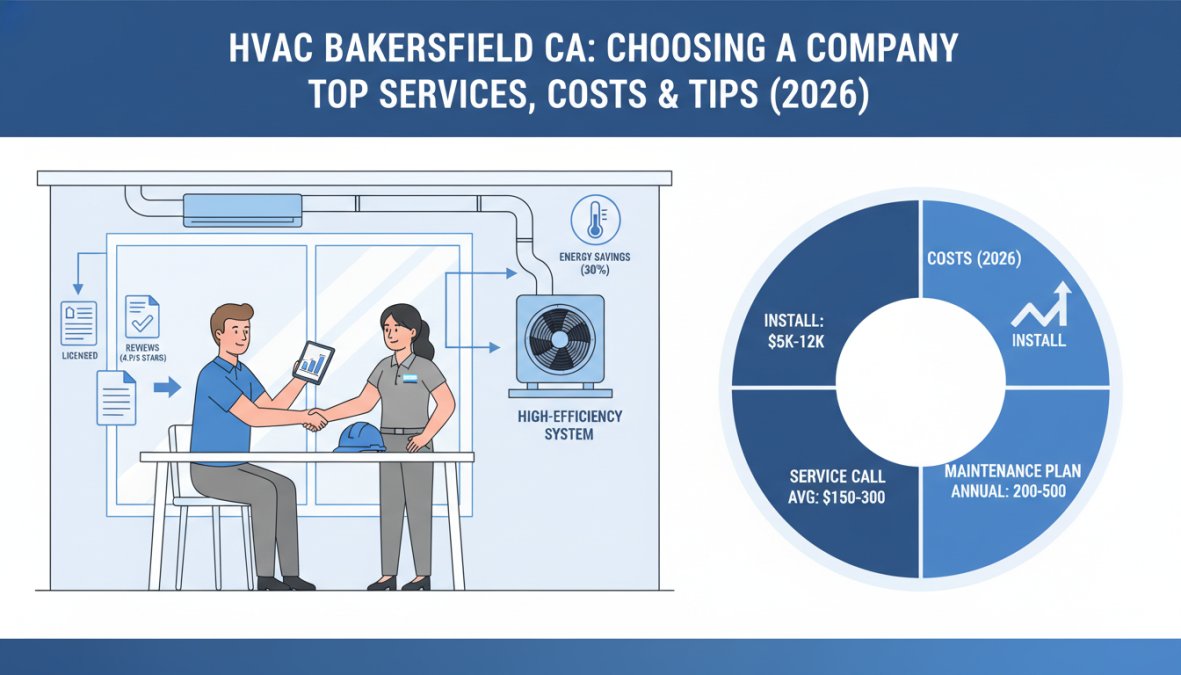
| Full System Replacement (AC + Furnace) | $5,000 – $12,000+ | Varies by system size, SEER rating, and ductwork condition |
| Ductwork Replacement | $2,000 – $6,000 | Highly variable by home size |
These ranges reflect general market conditions. Always get at least three quotes for any job over $500.
Ask every contractor for a written itemized quote before authorizing work. A contractor who refuses to itemize labor and parts separately is a contractor worth avoiding.
HVAC Maintenance Tips That Bakersfield Homeowners Actually Need
Most HVAC maintenance advice is written for generic climates. Bakersfield homeowners need a more aggressive schedule, full stop.
Seasonal Maintenance Checklist for Heating and Cooling Systems
A preventative maintenance plan tailored to Kern County conditions will extend system life and reduce emergency repair calls. The goal is to catch small problems before they become expensive ones.
Spring (March-April) – Pre-Cooling Season:
- Replace air filter
- Clean condenser coils with a gentle hose-down (power off first)
- Clear vegetation and debris from around the outdoor unit
- Test thermostat accuracy and replace batteries
- Check refrigerant lines for visible damage or frost
- Schedule a professional tune-up before peak season demand drives wait times up
Fall (October-November) – Pre-Heating Season:
- Replace air filter again
- Test furnace ignition before the first cold night
- Inspect heat exchanger for cracks (a cracked heat exchanger is a carbon monoxide risk)
- Check all ductwork connections in accessible areas
- Test carbon monoxide detectors
Year-Round (Monthly in Bakersfield):
- Inspect air filter; replace if visibly dirty
- Verify thermostat is functioning correctly
- Listen for unusual sounds during startup and operation
According to California Energy Commission guidance on HVAC maintenance, regular preventative maintenance is one of the most cost-effective ways to manage home energy costs in high-demand climates like the Central Valley.
Indoor Air Quality, Ductwork, and Energy Efficiency Solutions
The air inside a Bakersfield home can be significantly more polluted than outdoor air when HVAC systems aren’t properly maintained or upgraded. This is the part of HVAC Bakersfield, CA service that most homeowners overlook until someone in the household develops respiratory symptoms.
Air Filtration and Ventilation System Upgrades
Standard 1-inch fiberglass filters do almost nothing for fine particulate matter. For Bakersfield homes, a minimum MERV-8 filter is a reasonable baseline, and MERV-11 or MERV-13 filters are worth the additional cost if anyone in the household has allergies or asthma. The tradeoff is increased airflow restriction, which means your system works slightly harder. A technician can confirm your system can handle the upgrade without reducing efficiency.
Beyond filtration, whole-home air purification systems and UV germicidal lights can be integrated into existing ductwork. UV lights installed at the coil location genuinely reduce mold and bacterial growth on evaporator coils, which is a real problem in systems that run constantly in humid conditions.
Ventilation system health matters too. Leaky ductwork in unconditioned spaces like attics and crawlspaces can reduce system efficiency dramatically. A duct blaster test can quantify leakage; sealing and insulating ducts in these spaces often produces measurable energy savings.
SEER Ratings, Energy Rebates, and How to Apply in Kern County
SEER2 (the updated efficiency metric that replaced SEER in 2023) measures how efficiently an air conditioning system converts electricity into cooling across a full season. California’s current minimum for new central AC installations is SEER2 14.3 for split systems in the climate zones covering Kern County, but systems rated SEER2 16 or higher are where meaningful utility rebates begin.
Bakersfield sits in one of the hottest climate zones in California, which makes the efficiency delta between a minimum-code system and a high-efficiency system larger here than almost anywhere else in the state. A system that runs 2,000+ hours per cooling season amplifies every tenth of a SEER2 point into real dollar savings on your PG&E or SCE bill.
Why this matters for equipment selection: When getting quotes for a replacement system, ask contractors to show you the SEER2 rating on the AHRI certificate, not just the marketing label on the equipment. The AHRI-certified rating reflects the matched system (indoor coil + outdoor unit + furnace) and is the number utilities use to determine rebate eligibility.
California switched from SEER to SEER2 standards in January 2023. Some contractors may still quote older SEER ratings when discussing equipment. A SEER2 14.3 system is roughly equivalent to a SEER 15 system under the old standard. Always confirm which rating system is being quoted.
Step-by-Step Guide to Claiming California Energy Rebates for HVAC in Kern County
This is the section most HVAC guides skip entirely. Here is the actual process for Kern County homeowners:
Step 1: Identify your utility provider.
Most of Bakersfield is served by Pacific Gas and Electric (PG&E) or Southern California Edison (SCE), depending on your specific address. A small number of properties fall under Kern River Valley Electric. Your rebate program depends entirely on which utility bills you, check your most recent utility statement if you’re unsure.
Step 2: Check current rebate offers BEFORE purchasing equipment.
Rebate programs change quarterly and sometimes expire without notice. Visit your utility’s rebate portal directly:
- PG&E residential rebates: PG&E Energy Efficiency Rebates portal
- SCE residential rebates: SCE Rebates and Savings portal
- Federal ENERGY STAR rebate finder (cross-references both utility and federal programs): ENERGY STAR rebate finder
Do not rely on a contractor to tell you what rebates are available. Verify independently.
Step 3: Confirm equipment eligibility before installation.
Most utility rebates require the installed equipment to appear on a pre-approved list (often tied to ENERGY STAR certification or a minimum SEER2 threshold). Ask your contractor for the model number of the proposed equipment and verify it against the utility’s eligible equipment list before signing a contract. Equipment installed before verification may not qualify even if a similar model does.
Step 4: Retain all documentation.
To claim most utility rebates, you will need:
- A copy of the contractor’s invoice showing equipment model numbers, installation date, and contractor license number
- The AHRI certificate for the installed system (your contractor should provide this)
- Proof of your utility account (account number and service address)
- In some cases, a pre-inspection or post-installation inspection may be required, ask your utility before installation begins
Step 5: Submit your rebate application promptly.
Most utility rebate programs require submission within 90 to 180 days of installation. Missing this window forfeits the rebate entirely. Submit online through your utility’s portal where possible; paper submissions take longer to process.
Step 6: Claim the federal tax credit separately.
The federal Inflation Reduction Act (IRA) provides a separate tax credit, currently up to 30% of the cost of qualifying high-efficiency HVAC equipment, with an annual cap, that is claimed on your federal income tax return using IRS Form 5695. This is not a rebate paid by your utility; it reduces your federal tax liability directly. Qualifying equipment categories include certain heat pumps, heat pump water heaters, and central air conditioners meeting specific efficiency thresholds. A tax professional can confirm your specific eligibility, but the key point is that the federal credit and utility rebates are not mutually exclusive, you can claim both on the same installation.
The correct order of operations is: (1) check rebate eligibility before purchase, (2) install qualifying equipment with a licensed contractor, (3) submit utility rebate within the deadline, (4) claim the federal IRA tax credit on your next return. Reversing steps 1 and 2 is the most common and most expensive mistake Bakersfield homeowners make.
What Kern County homeowners frequently miss: California’s TECH Clean California initiative, administered through BayREN and other regional energy networks, offers additional incentives specifically for heat pump installations that replace gas furnaces. Kern County falls within the SoCalREN service area for some programs. Check SoCalREN residential programs for current availability, as these programs are funded in cycles and close when funds are exhausted.
How to Choose an HVAC Company in Bakersfield the Right Way
Choosing the wrong HVAC contractor is an expensive mistake. Bakersfield has no shortage of companies offering HVAC Bakersfield, CA services, and the quality gap between the best and worst is significant.
Start with licensing. Every HVAC contractor in California must hold a C-20 (Warm-Air Heating, Ventilating and Air-Conditioning) license issued by the California Contractors State License Board. You can verify any contractor’s license status directly through the CSLB website. An unlicensed contractor performing HVAC work is a liability risk for the homeowner.
Next, verify insurance. General liability and workers’ compensation coverage protect you if something goes wrong during installation or repair. Ask for certificates of insurance before any work begins.
Check reviews across multiple platforms, not just the contractor’s own website. Look for patterns: repeated complaints about pricing surprises, missed appointments, or poor workmanship are more meaningful than a single negative review.
Red Flags to Avoid When Hiring a Local HVAC Contractor
A common mistake is choosing the lowest bidder without scrutinizing what’s included in the quote. Here’s what to watch for:
- No written estimate: Any contractor who won’t provide a written, itemized quote is a red flag.
- Pressure to decide immediately: Legitimate contractors don’t manufacture urgency.
- Recommending oversized equipment: Bigger is not better in HVAC. An oversized system will short-cycle and create humidity problems.
- No load calculation: A proper HVAC installation requires a Manual J load calculation. If a contractor quotes a replacement without measuring your home, they’re guessing.
- Refusing to pull permits: HVAC installations in California require permits. A contractor who suggests skipping permits to save money is exposing you to legal and insurance risk.
- No manufacturer warranty support: Certified installers can register equipment warranties with manufacturers. An uncertified installer may void your equipment warranty.
The real difference between a trustworthy HVAC company and a problematic one often comes down to transparency. Contractors who explain what they’re doing, why they’re recommending it, and what it will cost in writing are the ones worth hiring.
Emergency HVAC Services and What Bakersfield CA Homeowners Should Know
Emergency HVAC calls in Bakersfield are not a rare edge case, they are a predictable seasonal event. When temperatures exceed 105°F for consecutive days, local HVAC companies receive call volumes that can overwhelm their dispatch capacity. Understanding how emergency service works, what it costs, and how to protect yourself during a wait is practical knowledge every Kern County homeowner should have before they need it.
How Emergency HVAC Pricing Works (and What to Expect)
Most HVAC companies structure emergency service differently from standard appointments. Here is the typical pricing framework:
| Service Tier | When It Applies | Typical Premium |
|---|---|---|
| Standard appointment | Scheduled during business hours (M-F, 8am-5pm) | No premium; standard diagnostic fee applies |
| After-hours / weekend | Evenings, weekends, non-holiday | 1.5x to 2x standard labor rate |
| Emergency / same-day | Any time, immediate dispatch requested | Flat emergency fee ($100-$250) plus elevated labor rate |
| Holiday emergency | Major holidays | Highest tier; some companies charge double time |
These ranges reflect general market patterns. The diagnostic fee for an emergency call is often separate from and in addition to the emergency dispatch fee, confirm both before a technician is dispatched.
During Bakersfield heat events, some companies experience dispatch delays of 4 to 8 hours or longer even for emergency calls. Ask for an estimated arrival window when you call. If a company cannot give you any estimate, call the next company on your list.
What Qualifies as a True HVAC Emergency in Bakersfield
Not every system failure warrants emergency pricing. Knowing the difference helps you decide whether to pay the premium or schedule a next-day appointment.
Situations that justify emergency service:
- Complete AC failure with indoor temperatures above 85°F and household members who are elderly, under age 5, pregnant, or have cardiovascular or respiratory conditions
- Gas furnace failure with overnight temperatures forecast below 35°F
- Any situation involving a gas smell near the furnace or HVAC equipment, this is a utility emergency first; call SoCalGas or your gas provider before calling an HVAC company
- A cracked heat exchanger confirmed by a technician (carbon monoxide risk; do not operate the furnace)
- Refrigerant leak with visible ice formation and complete loss of cooling
Situations that can typically wait for a standard appointment:
- Reduced cooling performance without complete failure (system is running but not keeping up)
- Unusual noises without loss of function
- Thermostat display issues
- Single-zone problems in a multi-zone system where other zones are functional
How to Prepare Before You Need Emergency Service
The most effective emergency HVAC strategy is relationship-based. Homeowners who are enrolled in a maintenance plan with a local company are almost always prioritized over cold-call emergency requests during peak demand periods. Many Bakersfield HVAC companies explicitly state this policy: maintenance plan customers move to the front of the emergency queue.
If you don’t have a maintenance plan, establish a primary contractor before summer begins. Call in March or April for a tune-up, pay for the service, and save the company’s direct number, not just their website. When you call at 9 PM on a Friday in August, being a known customer with a service history matters.
Before the technician arrives, immediate steps to reduce indoor heat load:
- Close all window coverings on south- and west-facing windows immediately; solar gain through glass is a significant heat source
- Move to the lowest floor of the home, cooler air is denser and settles downward
- Turn off heat-generating appliances: ovens, dishwashers, clothes dryers, and even desktop computers add measurable BTUs to a space that can no longer be cooled
- Use portable fans to create cross-ventilation if outdoor temperatures drop below indoor temperatures (typically after 9-10 PM in Bakersfield summers)
- A box fan placed in a window facing outward exhausts hot indoor air; a second fan on the opposite side of the home draws cooler air in, this works meaningfully once outdoor temps fall below roughly 85°F
- If anyone in the household is in a vulnerable category, identify the nearest Kern County cooling center in advance. Kern County Public Health maintains a list of designated cooling centers during heat emergencies at Kern County Public Health heat emergency resources
What to Ask When You Call for Emergency Service
The conversation you have with the dispatcher determines a lot. Ask these questions before agreeing to a dispatch:
- What is the emergency dispatch fee, separate from the diagnostic fee? Get both numbers.
- Is the technician a licensed employee of your company, or a subcontractor? During peak demand, some companies pull in third-party technicians. This isn’t automatically a problem, but you should know.
- What is the estimated arrival window? Any reputable company can give you a range. If they refuse, that is meaningful information.
- If a repair is needed, will you provide a written quote before starting work? Confirm this expectation before the technician arrives, not after.
- Does your company warranty emergency repairs? Standard labor warranties apply to scheduled work; confirm they apply to emergency repairs as well.
Save the contact information for at least two licensed HVAC companies in Bakersfield before summer begins. During a heat event, your first-choice company may have a 6-hour wait. Having a backup number ready is not disloyal, it is practical.
According to California Department of Public Health guidance on heat-related illness prevention, extreme heat is one of the leading weather-related causes of illness and death in California. In Kern County, where heat events are longer and more intense than in most of the state, a functioning HVAC system is a health infrastructure issue, not a comfort preference. Treating emergency preparedness as a seasonal task, the same way you’d prepare for fire season, is the mindset that prevents the worst outcomes.
Frequently Asked Questions
How much does HVAC repair cost in Bakersfield, CA?
AC repair in Bakersfield typically ranges from $150 to $600 depending on the issue. Minor fixes like capacitor or thermostat replacements tend to cost less, while refrigerant recharges or compressor repairs run higher. Full HVAC system replacements in Bakersfield can range from $4,000 to $12,000 or more depending on system size and SEER rating. Always request upfront pricing from a licensed contractor before any work begins to avoid surprise charges.
How often should I service my AC in Bakersfield?
Bakersfield’s extreme heat and dusty Central Valley air put heavy strain on HVAC systems. Most HVAC technicians recommend servicing your air conditioning unit at least twice a year, once before summer and once before winter. Because of the high dust and pollen levels in Kern County, checking and replacing air filters every 30 to 60 days is also strongly advisable to maintain indoor air quality and system efficiency throughout the year.
What are the most common HVAC problems specific to Bakersfield’s climate?
Bakersfield’s triple-digit summer temperatures and dusty air create a few recurring HVAC issues: clogged air filters and dirty ductwork from Central Valley dust, refrigerant leaks caused by overworked compressors, frozen evaporator coils from restricted airflow, and thermostat failures from heat exposure. Capacitor burnout is also common because systems run nearly nonstop in summer. Regular preventative maintenance and filter changes can prevent most of these problems before they require costly AC repair in Bakersfield.
Do I need a permit for HVAC replacement in Bakersfield, CA?
Yes, most HVAC installations and full system replacements in Bakersfield require a permit through the City of Bakersfield or Kern County Building Department, depending on your location. A reputable, licensed contractor will pull the necessary permits on your behalf. Be cautious of any HVAC company that skips the permit process, unpermitted work can create problems when selling your home and may void manufacturer warranties on new equipment.
When should I replace rather than repair my HVAC system in Bakersfield?
A general rule is the ‘5,000 rule’: multiply the system’s age by the repair cost. If the result exceeds $5,000, replacement is often the smarter investment. In Bakersfield, where systems run hard due to extreme heat, most HVAC units have a practical lifespan of 12 to 15 years. If your system is over 10 years old, requires frequent repairs, or has a low SEER rating, upgrading to a modern energy-efficient unit can lower your utility bills significantly and qualify you for energy rebates.