Last Updated: June 02, 2026
Deciding whether solar property tax exclusion is worth it California is one of the most practical questions any homeowner or commercial property owner should ask before going solar. The answer, in short, is yes, and the financial case is stronger than most people realize. This guide from Discount Solar breaks down exactly how the exclusion works, who qualifies, and what steps you need to take to protect your property tax bill after installation. Below, we’ll show you exactly how to apply, what happens if you’re denied, and how to stack this benefit with other 2026 incentives.
The thing most guides miss is this: the exclusion doesn’t reduce your taxes. It prevents them from going up. That distinction matters enormously when you’re evaluating the true cost of going solar.
What Is the California Solar Property Tax Exclusion and Is It Worth It?
The California Solar Property Tax Exclusion is a state-level provision that prevents the added value of a qualifying solar installation from being counted in your property’s assessed value for tax purposes. Without it, adding solar panels to your home could trigger a reassessment that raises your annual property tax bill. With it, the California Revenue and Taxation Code directs county assessors to ignore the added market value of a qualified solar system when calculating your base year value.
This is not a tax refund or a credit. It’s a shield against reassessment.
Definition of Active Solar Energy System Exclusion
An Active Solar Energy System is a system that uses solar devices to collect, store, or distribute solar energy for space conditioning, water heating, process heat, or electricity generation connected to the California Independent System Operator grid. The exclusion applies specifically to these systems, meaning passive solar design features (like south-facing windows) do not qualify.
The exclusion has been a cornerstone of California’s renewable energy investment strategy for decades, and its scope has expanded through successive legislative extensions.
Exclusion vs. Exemption: What’s the Difference?
This is where most property owners get confused.
A tax exemption removes a property or portion of it from taxation entirely. A tax exclusion means a specific type of added value is excluded from the assessed value calculation. Under California law, the solar exclusion means your property is still assessed and taxed, just as if the solar system were never installed. The solar panels exist on your roof, but for property tax purposes, they are invisible to the assessor.
The practical effect is the same: you pay less in property taxes than you would without the provision. But the legal mechanism is different, and that distinction affects how you apply and what documentation you need.
The solar property tax exclusion prevents your property taxes from rising after installation. It does not reduce your existing tax bill, it freezes the assessment as if the solar system doesn’t exist.
Section 73 of the California Revenue and Taxation Code Explained
Section 73 of the California Revenue and Taxation Code is the legal foundation for the solar property tax exclusion. It authorizes county assessors across California to exclude the added value of a qualifying Active Solar Energy System from the property’s taxable assessed value. The provision applies to both new construction and improvements to existing structures, which makes it unusually broad compared to similar incentives in other states.
According to California State Board of Equalization guidance on solar property tax exclusions, the exclusion is self-executing in many counties, meaning the assessor may apply it automatically when a permit is pulled. However, relying on that automatic process is a common mistake. Filing directly with your county assessor is always the safer path.
Sunset Date, Senate Bill 1340, and Legislative Extensions
Section 73 has not been permanent law. It has required repeated legislative renewal, which creates real uncertainty for property owners planning long-term solar investments.
Senate Bill 1340 extended the exclusion’s sunset date, pushing the deadline for qualifying installations forward. As of 2026, the exclusion applies to Active Solar Energy Systems that are completed and operational by the current legislative deadline. Property owners should verify the exact operational deadline with their county assessor or the California Legislative Information database for current bill status, since sunset dates can shift with new legislative sessions.
The broader pattern here is worth noting: California has consistently renewed this exclusion because it directly supports the state’s renewable energy goals. Letting it lapse would create a financial roadblock for solar adoption. That political reality makes future extensions likely, but never guaranteed.
New Construction vs. Existing Property: How the Rules Differ
The exclusion applies differently depending on whether solar is installed as part of new construction or added to an existing property.
For new construction, the solar system’s value is excluded from the initial assessed value of the new structure. The base year value is set as if the solar infrastructure were not present.
For existing properties, adding solar does not trigger a reassessment of the entire property. Only the value attributable to the solar system itself is excluded. Your existing assessed value remains unchanged.
The practical difference: new construction buyers benefit from a lower starting assessment, while existing homeowners are protected from any upward reassessment triggered by the installation. Both scenarios produce meaningful tax savings over a 25-year system lifespan.
Eligibility Requirements: Does Your Solar System Qualify?
Not every solar installation qualifies for the exclusion. The system must meet specific criteria under Section 73, and meeting those criteria requires attention to detail during the planning and installation phase. The California State Board of Equalization has published guidance that breaks eligibility into three distinct tests: system type, functional purpose, and operational status. Failing any one of the three disqualifies the installation for that tax year.
Qualified Systems: Residential Solar vs. Commercial Solar
Both residential and commercial solar systems can qualify, but the definition of an Active Solar Energy System under California law is narrower than most homeowners assume. The system must meet all of the following:
- Active collection or conversion: The system must use mechanical or electrical components, inverters, pumps, heat exchangers, or photovoltaic cells, to collect and convert solar energy. Passive design features such as south-facing windows, thermal mass walls, or solar tubes do not qualify, even if they meaningfully reduce energy consumption.
- Qualifying end use: The converted energy must serve at least one of four approved purposes: space heating or cooling, domestic or service water heating, industrial or commercial process heat, or electricity generation. A system that serves only one purpose, say, a dedicated solar water heater, qualifies just as fully as a combined PV-plus-storage system.
- Grid deliverability for electricity systems: For photovoltaic systems that generate electricity, the system must be capable of delivering power to or receiving power from the California Independent System Operator (CAISO) network. This means the system must be grid-tied through a utility-approved interconnection. Fully off-grid systems, those with no utility interconnection at all, do not meet this requirement and are excluded from the exclusion.
What does not qualify:
- Solar-powered landscape or pathway lighting
- Small plug-in solar chargers and portable panels
- Decorative architectural solar features
- Off-grid cabins or structures with no CAISO-connected utility service
- Solar attic fans (these are typically classified as ventilation, not active energy systems)
Battery storage systems occupy a gray area. A standalone battery system installed without solar does not qualify. A battery system installed as an integrated component of a qualifying solar system, where the battery stores solar-generated electricity for later use, is generally treated as part of the qualifying system. However, county assessors have discretion in how they classify storage, and at least some counties have assessed battery additions separately. Confirm the treatment with your county assessor before assuming storage is automatically covered.
Operational Deadline and Lien Date Requirements
Two timing requirements determine whether your system qualifies in a given tax year, and both are firm.
The lien date rule: California property taxes are assessed based on the status and value of the property on January 1 of each tax year, this is the lien date. A system must be fully operational before that date to receive the exclusion for the corresponding tax year. A system installed and permitted in December but not yet operational on January 1 does not qualify for that tax year. It would qualify for the following year, assuming it is operational by the next January 1.
Practical example: A homeowner in Bakersfield completes installation on December 15, 2025. The utility interconnection is approved and the system begins producing power on December 28, 2025. That system is operational before January 1, 2026, and qualifies for the 2026-2027 tax year exclusion. If the interconnection approval is delayed until January 5, 2026, the system misses the lien date and the homeowner loses one full year of exclusion benefit.
The legislative sunset deadline: The system must also be completed within the window authorized by the current legislative extension of Section 73. This is a separate requirement from the lien date. Even if a system is operational before January 1, it must also have been completed before the sunset date specified in the most recent legislative extension. Property owners should verify the current sunset deadline directly with their county assessor or through the California Legislative Information database for current bill status, since the deadline has shifted with each renewal cycle.
What ‘operational’ means in practice: County assessors generally define operational as the point at which the system has received final inspection approval from the local building department and has been granted permission to operate (PTO) by the utility. A system that has passed inspection but is awaiting PTO is not yet operational for exclusion purposes. Coordinate with your installer to track both milestones, not just the inspection.
Do not assume your installer will handle the exclusion filing or monitor the lien date on your behalf. Many installers complete their contractual obligation at final inspection and do not track utility PTO timelines. A system that misses the January 1 lien date by even a few days costs you an entire year of exclusion benefit. Build the PTO timeline into your installation contract and confirm it in writing before signing.
New Construction vs. Existing Property: How the Rules Differ
The exclusion applies differently depending on whether solar is installed as part of new construction or added to an existing property, and the financial stakes differ meaningfully between the two scenarios.
For new construction: The solar system’s value is excluded from the initial base year value set at the time of construction completion. The assessor establishes the property’s taxable value as if the solar infrastructure were not present. Because the base year value under Proposition 13 is the anchor for all future assessments, increasing by no more than two percent annually, a lower starting base year value compounds into significant savings over a 20- to 30-year ownership horizon.
For existing properties: Adding solar to an existing home does not trigger a reassessment of the entire property. Under California’s Proposition 13 framework, a reassessment is only triggered by a change in ownership or new construction. The solar installation is technically new construction, but Section 73 directs the assessor to exclude its value from the new construction calculation. The result: your existing assessed value is unchanged, and the solar system adds nothing to it.
The practical difference between the two scenarios is this: new construction buyers benefit from a lower starting assessment that protects them for the life of their ownership. Existing homeowners are protected from the specific upward adjustment that would otherwise result from the installation. Both outcomes are meaningful, but the new construction benefit is larger in absolute dollar terms because it affects the base from which all future increases are calculated.
For existing homeowners, the exclusion is a shield. For new construction buyers, it is a foundation. In both cases, the benefit compounds annually under Proposition 13’s two-percent cap, making early installation more valuable than late installation over a typical ownership period.
How to Apply for the Solar Property Tax Exclusion in California
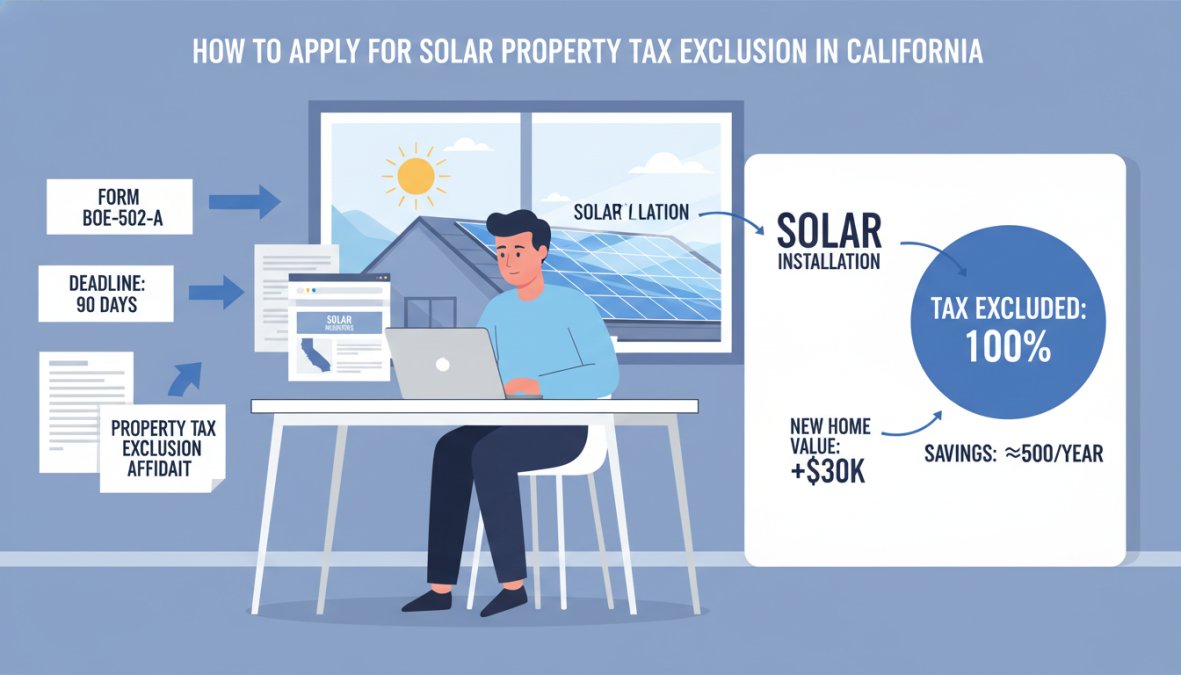
Applying for the solar property tax exclusion is straightforward, but it requires proactive follow-through. The process is handled at the county level, which means procedures vary slightly between Kern County, Los Angeles County, and other jurisdictions.
Step-by-Step Application Process with Your County Assessor
- Confirm your system qualifies. Review the Active Solar Energy System definition under Section 73 with your installer. Get written confirmation that the system meets all functional requirements.
- Obtain your installation permit and completion documentation. Your county assessor will need proof that the system was installed and operational before the relevant lien date.
- Locate your county assessor’s exclusion form. Most California counties have a specific form for the solar exclusion. In Kern County, this is available directly through the assessor’s office website.
- Submit the application before the filing deadline. Many counties require the application within a set window after installation. Filing late may result in the exclusion being applied only prospectively.
- Retain copies of all submitted documents. Keep your permit, completion certificate, and filed application in a permanent file. You may need these if your property is sold or if a reassessment is triggered.
- Follow up with the assessor’s office. Confirm receipt and ask for written acknowledgment that the exclusion has been applied to your account.
The entire process typically takes two to four weeks if documentation is in order.
What to Do If Your Exclusion Is Denied: The Appeals Process
Denials happen, usually because of incomplete documentation or a dispute over whether the system qualifies as an Active Solar Energy System.
If your exclusion is denied, you have the right to appeal to the county Assessment Appeals Board. The appeal process generally involves:
- Filing a formal appeal application within 60 days of the denial notice
- Preparing documentation that demonstrates your system meets the statutory definition
- Presenting your case at a hearing before the Appeals Board
Most denials are resolved at the documentation stage, before a formal hearing is necessary. The strongest appeals include the original installation permit, the system’s technical specifications, and a written statement from the installer confirming the system’s function and grid connection status.
Request a written explanation for any denial. Assessors are required to specify the basis for rejection, and that explanation tells you exactly what documentation gap to address in your appeal.
Does Solar Add Value to Your Home for Tax Purposes?
Solar panels do add measurable market value to a California home, and that creates a direct tension with property tax law. The exclusion exists precisely to resolve that tension in the homeowner’s favor.
Impact on Property Tax Assessment and Base Year Value
Without the Section 73 exclusion, a county assessor would be required to include the value added by solar panels in the property’s assessed value. This would raise the base year value and, consequently, the annual property tax bill. The exclusion prevents this by directing assessors to treat the solar system as if it were not part of the property for assessment purposes.
The base year value is the foundation of California’s Proposition 13 framework. Once set, it can only increase by a maximum of two percent per year absent a change in ownership or new construction. By keeping the solar system out of the base year value calculation, the exclusion ensures that the Proposition 13 cap continues to protect the homeowner from compounding tax increases tied to the solar investment.
Solar Panels and Property Resale Value
Here’s where the picture gets more nuanced. When you sell a home with solar panels, the buyer benefits from lower electricity costs, and the market typically reflects that in a higher sale price. But because the exclusion travels with the system, not the owner, the new buyer inherits the same protection.
According to Lawrence Berkeley National Laboratory research on solar home valuation, solar installations consistently add to residential sale prices in California markets. The exclusion means that added value does not automatically translate into a higher property tax bill for the new owner, making solar-equipped homes more attractive to buyers who understand the tax treatment.
The takeaway for sellers: solar adds value at sale without adding ongoing tax burden. That’s a rare combination in California real estate.
California Solar Tax Incentives in 2026: Stacking Your Savings
The property tax exclusion is one piece of a larger incentive landscape. Understanding how these incentives interact, not just that they exist, is where the real financial planning happens. Most guides list the programs. This section explains the mechanical relationships between them, including the interactions that can quietly reduce your benefit if you sequence them incorrectly.
Interaction with Federal Tax Credits and Other Incentives
California homeowners installing solar in 2026 can access multiple layers of tax relief simultaneously. The current federal Investment Tax Credit (ITC) allows qualifying residential solar installations to offset a percentage of system costs against federal income tax liability. The credit applies to the full installed cost of the system, including equipment, labor, and, importantly, battery storage when installed as part of a solar system.
The property tax exclusion and the federal ITC operate on entirely separate legal tracks and do not reduce each other. Claiming one does not affect eligibility for the other. A homeowner can simultaneously:
- Claim the federal ITC on their federal income tax return for the year the system is placed in service
- Apply for the California solar property tax exclusion with their county assessor
- Receive net metering credits on their utility bill under California’s current NEM framework
- Apply for the Self-Generation Incentive Program (SGIP) rebate if battery storage is included
The one interaction that does reduce a benefit, and that most guides skip entirely:
If you receive a utility rebate or a state rebate for your solar installation, that rebate reduces the tax basis on which you calculate the federal ITC. The IRS treats utility rebates as a reduction in the cost of the system, not as income. So if your system costs $30,000 installed and you receive a $3,000 utility rebate, your ITC is calculated on $27,000, not $30,000. The SGIP rebate for battery storage follows the same logic. This does not eliminate the ITC, it modestly reduces it, but it is a sequencing consideration worth discussing with a tax professional before you finalize your installation contract.
The California property tax exclusion has no effect on the federal ITC basis calculation. The exclusion is a property tax mechanism, not an income tax mechanism, and the IRS does not treat it as a subsidy that reduces system cost.
NEM 3.0 and How It Changes the Stacking Equation
This is the angle most 2026 guides are still missing. California’s net metering framework shifted to NEM 3.0 for new applicants, and that shift materially changes how homeowners should think about the combined value of the incentive stack.
Under NEM 3.0, the export rate paid for excess solar electricity sent to the grid is substantially lower than under the previous NEM 2.0 framework. The practical effect is that the financial return on a solar system now depends more heavily on self-consumption, using the power you generate rather than exporting it, and on battery storage that allows you to shift consumption to avoid high time-of-use rates.
How this interacts with the property tax exclusion:
- Systems sized for maximum self-consumption under NEM 3.0 tend to be larger, which means higher installed cost and a higher absolute value of the property tax exclusion (since more assessed value is shielded)
- Battery storage added to capture NEM 3.0 economics is generally treated as part of the qualifying Active Solar Energy System for exclusion purposes, meaning the storage component’s value is also excluded from assessment
- The SGIP rebate for battery storage reduces the ITC basis as noted above, but the property tax exclusion still applies to the full system including storage
For homeowners in Kern County and the Central Valley, where peak summer electricity rates are among the highest in the state, the NEM 3.0 shift actually increases the relative value of the property tax exclusion because it incentivizes larger, storage-integrated systems, and larger systems generate more excluded assessed value.
Impact on Property Resale Value: The Angle Competitors Miss
This is the interaction most guides ignore entirely, and it matters for any homeowner who does not plan to stay in their home for the full 25-year system life.
Solar panels consistently add to residential sale prices in California markets, as documented in research from Lawrence Berkeley National Laboratory on solar home valuation. The property tax exclusion means that added market value does not translate into a higher property tax bill, for the current owner or for the buyer.
Here is the mechanism: when a home with solar is sold, the sale triggers a Proposition 13 reassessment. The new base year value is set at the purchase price. Without the Section 73 exclusion, the assessor would include the value attributable to the solar system in that new base year value, raising the buyer’s starting tax assessment. With the exclusion in place, the assessor excludes the solar system’s value from the reassessment calculation, even though the buyer paid a higher price that reflects the solar premium.
What this means for sellers: Solar adds value at sale without adding ongoing tax burden for the buyer. That is a rare combination in California real estate, and it is a legitimate selling point that most real estate agents do not know to communicate.
What this means for buyers: If you are purchasing a home with an existing solar system, confirm with the county assessor that the Section 73 exclusion will be applied to your reassessment. In most counties this is automatic, but it is worth verifying, particularly if the system was installed recently and the exclusion was never formally filed by the previous owner.
The documentation gap at resale: If the previous owner never filed for the exclusion, the system’s value may have been included in the assessed value all along. A buyer who discovers this after closing has the right to file for the exclusion prospectively and, in some counties, to appeal the assessment retroactively. This is an underused remedy that most buyers and their agents are unaware of.
| Incentive | Type | Applies To | Administered By | Affects ITC Basis? |
|---|---|---|---|---|
| Section 73 Exclusion | Property tax | Residential + Commercial | County Assessor | No |
| Federal ITC | Income tax credit | Residential + Commercial | IRS | N/A (is the credit) |
| Net Metering (NEM 3.0) | Utility bill credit | Grid-tied systems | Utility company | No |
| SGIP (Storage) | Rebate | Battery storage | CPUC | Yes, reduces basis |
| Utility cash rebates | Rebate | Varies by utility | Utility company | Yes, reduces basis |
Before finalizing your installation contract, ask your installer to provide a written breakdown of which incentives you are applying for and in what order. The sequencing of rebates relative to the ITC calculation is the one area where a tax professional’s input, even a single consultation, can protect a meaningful portion of your federal credit.
Discount Solar’s certified installers help Bakersfield and Kern County homeowners navigate all of these programs during the design phase, so nothing gets left on the table and no rebate inadvertently reduces a credit you were counting on.
Is the Solar Property Tax Exclusion in California Really Worth It? Our Verdict
The honest answer: yes, unambiguously, for any homeowner who installs a qualifying system and files correctly.
The exclusion eliminates what would otherwise be a recurring annual cost tied directly to your solar investment. Over a 25-year system lifespan, the cumulative property tax savings are real and material. The application process takes a few hours. The financial benefit compounds every year.
The one caveat is legislative uncertainty. The exclusion has required repeated renewal, and a future legislature could allow it to lapse or narrow its scope. That risk is real, but the current trajectory, given California’s renewable energy mandates, makes continued extension the most likely outcome.
For homeowners in Kern County and the broader Central Valley, where property values and solar irradiance both support strong system economics, the exclusion removes one of the last remaining financial roadblocks to going solar. The combination of the federal credit, net metering, and the property tax exclusion means the effective cost of a solar system is substantially lower than the sticker price suggests.
The verdict on is solar property tax exclusion worth it California is clear: the exclusion is worth pursuing, the application is manageable, and the long-term savings are significant.
Many California homeowners hesitate on solar because they worry about unexpected costs, including rising property taxes after installation. Discount Solar has spent a decade helping homeowners in Bakersfield and Kern County go solar with full confidence in the financial outcome. With a 25-year equipment warranty, certified installers, and custom solutions designed for your specific roof and energy needs, we make the process straightforward. Get your estimate from Discount Solar and see exactly what your system will cost, what you’ll save, and how the property tax exclusion applies to your situation.
Frequently Asked Questions
Does solar increase property tax in California?
No. Thanks to the Active Solar Energy System Exclusion under Section 73 of the California Revenue and Taxation Code, a qualifying solar installation is excluded from triggering a reassessment of your property’s base year value. This means your property tax bill will not increase simply because you added solar panels, making it one of the most valuable property tax incentives available to California homeowners and businesses investing in renewable energy.
How do I claim the solar property tax exclusion in California?
To apply for the solar property tax exclusion in California, you typically need to file a claim form with your county assessor’s office after your qualified system becomes operational. The form notifies the assessor that the new construction meets the criteria for exclusion under Section 73. Requirements and deadlines can vary by county, so contact your local county assessor promptly after installation to ensure your exclusion is applied correctly and on time.
Is the solar property tax exclusion permanent in California?
The solar property tax exclusion is not permanent, it has a sunset date. Section 73 has been extended multiple times through legislation, including via Senate Bill 1340. The exclusion currently applies to qualifying active solar energy systems installed before the applicable sunset date. Homeowners planning a solar installation should verify the current expiration date and ensure their system is operational before the deadline to lock in the exclusion and avoid a reassessment.
Does the solar property tax exclusion apply to leased solar panels?
Generally, the exclusion under Section 73 applies to the property owner, not the equipment owner. If you lease your solar panels, the solar company typically retains ownership of the system, which may affect your eligibility for the property tax exclusion. Homeowners who purchase their solar system outright or finance it through a loan are more likely to qualify. Always confirm your specific situation with your county assessor or a tax professional before assuming the exclusion applies.
Can the California solar property tax exclusion be combined with other incentives in 2026?
Yes. The California solar property tax exclusion can generally be combined with other California solar tax incentives and the federal Investment Tax Credit (ITC) in 2026. These incentives operate at different levels, federal, state, and local, and are not mutually exclusive. Stacking the property tax exclusion with the federal tax credit and any available net metering benefits can significantly reduce both your upfront costs and your long-term tax burden, maximizing your overall renewable energy investment.
How much money can I save with the California solar property tax exclusion?
The amount you save depends on your property’s market value, your local tax rate, and the added value of your solar system. Because the exclusion prevents your property from being reassessed at a higher value after installation, you avoid paying ongoing annual property taxes on the value the solar system adds. Over many years, this can represent thousands of dollars in cumulative tax savings, making the exclusion a meaningful financial benefit on top of reduced electricity bills.