Last Updated: May 27, 2026
What is the 33% rule in solar panels? It’s actually two separate rules that share the same number, and confusing them is one of the most common mistakes homeowners and installers make. This guide from Discount Solar breaks down both definitions clearly, explains how each one affects your installation, and shows you what happens when either rule gets ignored. Below, we’ll walk through the fire code side, the system design side, and how both rules play out in a real home installation.
Here’s what most guides get wrong: they treat the 33% rule as a single concept. It isn’t. One version is a safety regulation enforced by fire departments. The other is an engineering principle that affects how much power your system produces. Both matter. Neither is optional.
What Is the 33% Rule in Solar Panels? The Two Meanings You Need to Know
The 33% rule in solar panels refers to two distinct principles: a fire code requirement that limits solar panel coverage to no more than two-thirds of a roof surface, preserving access pathways for emergency personnel, and a system design guideline recommending that a solar array’s DC capacity not exceed the inverter’s AC rating by more than roughly one-third.
Understanding which definition applies to your situation determines whether you’re talking to a fire marshal or an electrical engineer. Both versions exist to protect something: one protects people, the other protects your equipment and your return on investment.
The Fire Code Definition: Roof Coverage Limits
The fire code version of the 33% rule states that solar panels should not cover more than approximately two-thirds of a roof’s total surface area. The remaining one-third must stay clear to provide firefighters with safe access pathways, ventilation zones, and emergency egress routes.
This rule originates from guidance developed by fire safety organizations and has been adopted, in varying forms, across many jurisdictions in the United States and internationally. The core concern is straightforward: a roof covered entirely in photovoltaic (PV) panels creates a hazardous surface for firefighters who need to ventilate a structure during a fire. Panels are slippery, electrically live even when the breaker is off, and obstruct the ability to cut ventilation holes.
Solar panels remain energized during daylight hours even when the main breaker is switched off. Firefighters cannot safely de-energize PV panels on-site, which is precisely why roof access pathways are non-negotiable under fire code.
The System Design Definition: Inverter Oversizing
The system design version of the 33% rule relates to the DC/AC ratio of your solar array. Specifically, it suggests that the total DC capacity (measured in kilowatt-peak, or kWp) of your solar panels can exceed the inverter’s AC rating by up to roughly 33%, without causing significant problems.
A DC/AC ratio of 1.33 is widely considered the practical sweet spot for most residential installations. This means a solar array with 6.65 kWp of DC capacity paired with a 5 kW AC inverter sits right at that ratio. The reasoning is grounded in real-world physics: solar panels rarely hit their rated peak output simultaneously, so a modestly oversized array captures more energy during morning and evening hours without overwhelming the inverter during peak sunlight.
Solar Panel Fire Code Setbacks: Why Roof Access Pathways Matter
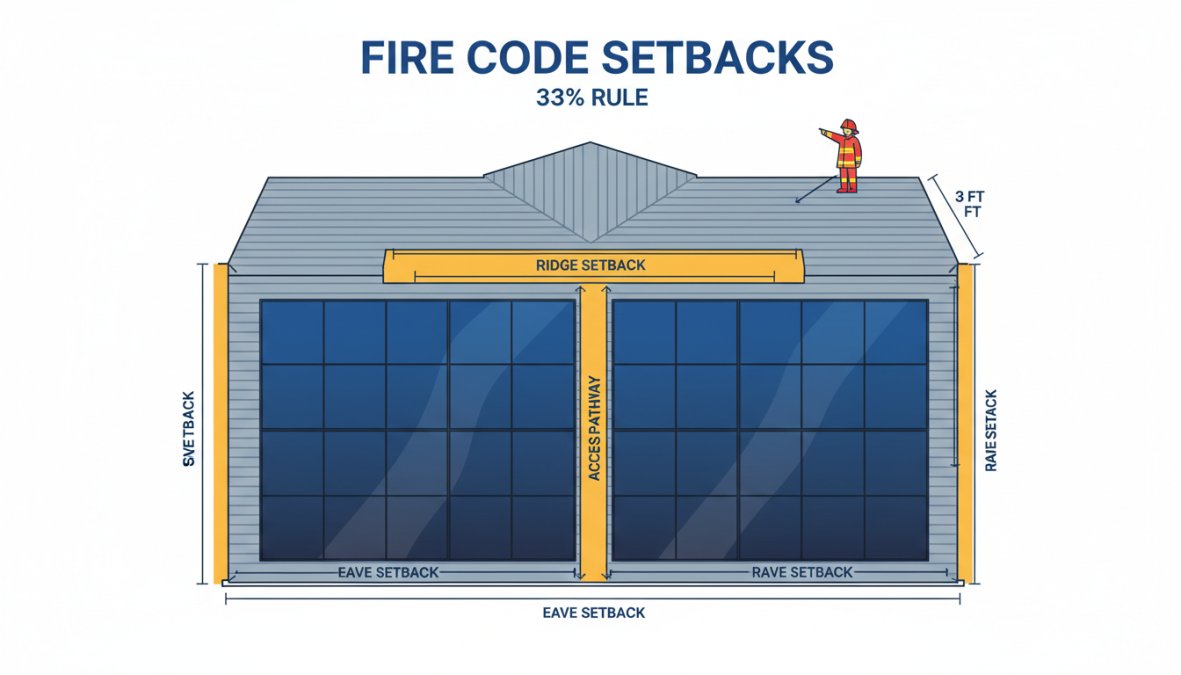
Solar panel fire code setbacks are clearance zones, typically measured in feet, that must remain free of panels along roof ridges, edges, hips, and valleys. These pathways exist so that firefighters can safely move across a roof, ventilate the structure, and reach problem areas without being blocked by a continuous field of photovoltaic panels.
According to the National Fire Protection Association’s guidance on PV systems, the fundamental concern is that panels create a continuous energized surface that cannot be safely interrupted during an active fire. Access pathways break that surface into manageable sections.
Typical setback requirements in many U.S. jurisdictions include:
- A minimum 3-foot clear pathway along the ridge of the roof
- A minimum 3-foot clear pathway along each hip and valley
- Clear access from the eave to the ridge on at least one side of each roof section
- Additional setbacks near skylights, vents, and other roof penetrations
These numbers vary by jurisdiction, which is why solar panel permitting requirements exist in the first place.
How Different Roof Types and Shapes Affect Setback Requirements
A simple rectangular gable roof is the easiest case: one ridge, two slopes, straightforward pathway placement. Complex rooflines introduce real complications.
Hip roofs require pathways along every hip line, which can significantly reduce the available installation area. L-shaped or multi-gabled roofs may require separate pathway systems for each roof section. Flat commercial roofs often follow different rules entirely, typically requiring perimeter setbacks rather than ridge-based pathways.
The practical takeaway: a homeowner with a complex roofline may find that fire code setbacks reduce their usable roof area well below the theoretical two-thirds maximum. In some cases, the effective coverage limit drops closer to 50% once all required pathways are mapped out.
Before finalizing your solar panel system sizing, ask your installer to produce a roof coverage map that shows all required setback zones. This prevents surprises during the permitting process and ensures your system design matches what the fire marshal will actually approve.
Regional Variations: How the 33% Rule Differs by Jurisdiction
The 33% roof coverage figure is a common benchmark, not a universal law. Different jurisdictions have adopted different standards, and the specific requirements in your area may differ meaningfully from the general rule.
In California, the California Fire Code requirements for solar photovoltaic systems specify detailed setback dimensions that local fire departments can modify. Some California counties require wider pathways than the state minimum. In the UK, fire safety guidance for PV installations follows separate frameworks developed by national building standards bodies. Australia, Germany, and other markets with high solar adoption have their own codes, some stricter and some more permissive than U.S. standards.
The consistent thread across jurisdictions is the underlying principle: emergency personnel need unobstructed access. The specific dimensions are the variable.
DC to AC Ratio Solar: Understanding Inverter Oversizing
The DC to AC ratio in a solar system is the relationship between the total rated DC output of the solar panels and the maximum AC output of the inverter. A ratio of 1.0 means the DC capacity exactly matches the inverter’s AC rating. A ratio of 1.33 means the DC capacity is one-third larger than the AC rating.
Inverter oversizing is standard practice in solar system design for a straightforward reason: solar panels almost never produce their rated peak wattage under real-world conditions. Soiling, shading, temperature, voltage drop, and the angle of the sun all reduce actual output below the nameplate figure. Sizing the DC array slightly larger than the inverter’s AC rating compensates for these losses and captures more usable energy across the full day.
What Happens When You Exceed or Fall Below the Ideal DC/AC Ratio
Going too high on the DC/AC ratio creates a problem called inverter clipping. When the solar array produces more power than the inverter can process, the excess is simply discarded. A ratio above 1.5 typically results in meaningful clipping losses, particularly in locations with long periods of direct peak sunlight.
Going too low creates a different problem: an undersized array never pushes the inverter to operate at its most efficient range, and the system produces less energy than it could.
The practical range most installers target is 1.1 to 1.4, with 1.25 to 1.33 being the most common for residential systems in high-sunlight regions like Bakersfield and Kern County. In areas with frequent cloud cover or significant shading, a lower ratio may be more appropriate.
| DC/AC Ratio | Effect | Best For |
|---|---|---|
| Below 1.0 | Underperforming inverter | Rarely recommended |
| 1.0 – 1.1 | Conservative, minimal clipping | Cloudy climates |
| 1.1 – 1.33 | Optimal balance | Most residential installs |
| 1.33 – 1.5 | Moderate clipping risk | High-sunlight regions |
| Above 1.5 | Significant clipping losses | Not recommended |
Solar Panel System Sizing and the 33% Rule in Practice
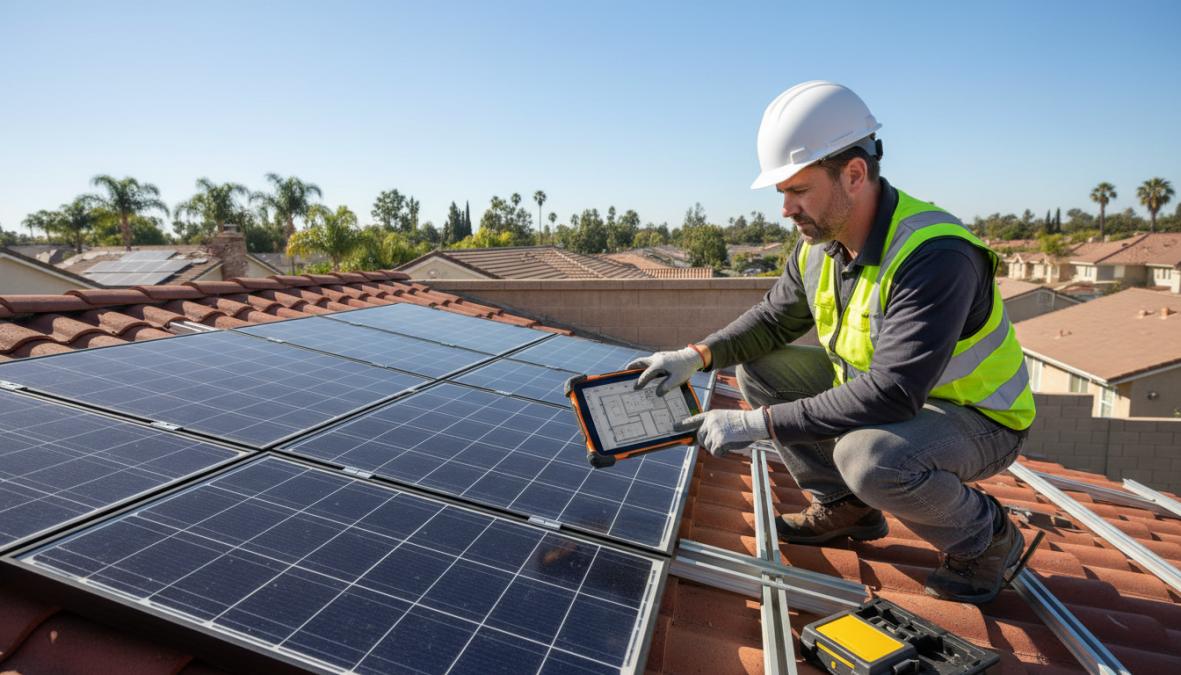
Solar panel system sizing is the process of determining how many panels, what inverter capacity, and what battery storage (if any) a home needs to meet its energy goals. Both versions of the 33% rule constrain this process from different directions.
The fire code version sets a ceiling on how many panels can physically fit on the roof. The DC/AC ratio version sets a guideline for how those panels should be matched to the inverter. A well-designed system respects both constraints simultaneously.
Key factors that feed into system sizing include:
- Annual household energy consumption in kilowatt-hours (kWh)
- Available roof area after fire code setbacks are applied
- Roof orientation and tilt angle
- Local peak sunlight hours
- Expected soiling and shading losses
- Grid connection requirements and net metering rules
- Battery storage goals and energy independence targets
Real-World Example: Applying Both 33% Rules to a Home Installation
Picture a typical single-story home in Bakersfield with a 2,000 square foot gable roof. After mapping fire code setbacks along the ridge and both rakes, the usable installation area comes to approximately 1,200 square feet, or 60% of the total roof surface. That’s within the fire code limit.
The homeowner’s annual consumption suggests a 7 kWp system would cover most of their usage. The installer selects a 6 kW AC inverter, giving a DC/AC ratio of 7.0 / 6.0 = 1.17, comfortably within the optimal range. The system fits within the fire code envelope, the inverter is appropriately sized, and the system is designed to minimize clipping while maximizing real-world energy production.
This is what it looks like when both 33% rules work together rather than in conflict.
Solar Panel Permitting Requirements Tied to the 33% Rule
Solar panel permitting requirements exist at the intersection of building codes, electrical codes, and fire codes. In most U.S. jurisdictions, a residential solar installation requires at minimum a building permit, an electrical permit, and a fire department review.
The fire code setback requirements are typically verified during the permitting review. Installers must submit a roof plan showing panel placement, setback dimensions, and pathway widths. Inspectors check that the installation matches the approved plans before the system can be energized.
According to the U.S. Department of Energy’s SolarApp+ permitting resource, simplified permitting processes are reducing approval times in many jurisdictions, but the underlying code requirements, including setback rules, remain in force regardless of how quickly the permit is issued.
A common mistake is submitting permitting drawings that show panel coverage at or near the maximum allowable limit without accounting for local amendments to the state fire code. Many California counties have stricter setback requirements than the state baseline, and a drawing that passes state code review may still be rejected at the local level.
Common Mistakes Homeowners Make With the 33% Rule
Most homeowners encounter the 33% rule for the first time during the permitting process, which is already too late to make major design changes without cost. The mistakes tend to cluster around a few predictable patterns.
Assuming the roof can be fully covered. The most common misconception is that panels can go anywhere there’s available roof space. Fire code setbacks remove a meaningful portion of that space, and complex rooflines remove more.
Ignoring the DC/AC ratio during the quote stage. Some installers quote systems based on panel count alone without specifying the inverter size. A homeowner who receives a quote for a 10 kWp array should always ask what inverter AC rating is included. A 7.5 kW inverter gives a ratio of 1.33; a 6 kW inverter gives a ratio of 1.67, which risks significant clipping losses.
Not asking about local fire code amendments. State codes set minimums. Local jurisdictions can and do add requirements. Always confirm setback requirements with the local authority having jurisdiction (AHJ), not just the state code.
Overlooking the impact of shading on DC/AC ratio optimization. A system designed with a 1.33 ratio assumes relatively unobstructed panels. If a new tree or neighboring structure creates shading, the effective DC output drops and the ratio assumption breaks down.
Submitting permitting documents that don’t reflect actual local fire code setback requirements is one of the most expensive mistakes in solar installation. Permit rejections delay installation, require redesign fees, and can push back your grid connection by weeks.
How the 33% Rule in Solar Panels Affects Your ROI and Energy Independence
The ROI of a solar installation is directly shaped by how well the system design navigates both versions of the 33% rule. A system that maximizes panel coverage within fire code limits captures more energy. A system with an optimized DC/AC ratio wastes less of that energy to clipping. Both factors compound over the 25-year lifespan of a well-installed system.
Energy independence, the goal of generating enough power to meaningfully reduce or eliminate grid dependence, requires accurate system sizing from the start. An undersized system because the installer didn’t account for setbacks, or an oversized array clipping against an undersized inverter, both erode the energy independence goal.
According to Lawrence Berkeley National Laboratory’s Tracking the Sun report, residential solar systems in California consistently perform close to modeled projections when properly designed and installed. The gap between projected and actual performance is most often traced to shading, soiling, and inverter sizing errors, all factors that a thorough application of the 33% rule principles helps prevent.
Portable solar and energy storage with batteries extend the equation further. A well-sized solar array paired with a battery bank reduces dependence on the grid during evening hours and provides backup power during outages. The same DC/AC ratio principles apply to battery inverter sizing, making the 33% design rule relevant beyond the basic grid-connected installation.
Designing a solar system that satisfies fire code requirements, optimizes inverter performance, and delivers genuine long-term savings requires experience with both sides of the 33% rule. Discount Solar brings a decade of certified installation experience to homeowners in Bakersfield and Kern County, backed by a 25-year equipment warranty and custom system designs that account for local permitting requirements from day one. Get your estimate from Discount Solar and start generating clean electricity on a system built to perform for decades.
Frequently Asked Questions
What is the purpose of the 33% rule in solar panel installation?
The 33% rule in solar panels actually has two distinct purposes. The first is a fire code safety guideline that limits how much of a rooftop a solar array can cover, ensuring firefighters and emergency personnel have clear access pathways to ventilate and navigate a roof safely. The second relates to solar system design, specifically the DC to AC ratio, where the solar array’s DC capacity can be sized up to roughly 133% of the inverter’s AC rating to maximize energy harvest during peak sunlight hours.
Does the 33% rule mean I can’t cover more than 33% of my roof with solar panels?
Not exactly. The fire code interpretation of the 33% rule doesn’t limit total roof coverage to 33%, it requires that at least a certain portion of the roof remain clear for setbacks and access pathways. In many US jurisdictions, panels cannot cover the ridge or be placed within set distances from roof edges. The exact coverage limits vary by local building codes and jurisdiction, so checking your local permitting requirements before installation is essential.
What is the ideal DC to AC ratio for a solar panel system, and how does the 33% rule apply?
The DC to AC ratio refers to the relationship between your solar array’s kilowatt-peak (kWp) DC capacity and your inverter’s AC rating. A ratio of around 1.2 to 1.33, meaning the DC capacity is up to 33% larger than the inverter’s AC output, is commonly considered optimal. This inverter oversizing strategy accounts for real-world losses from soiling, shading, voltage drop, and temperature, helping maximize energy production without significantly increasing costs.
What are the solar panel permitting requirements related to the 33% rule?
Solar panel permitting requirements that relate to the 33% rule typically involve submitting a roof plan showing setbacks, access pathways, and the percentage of roof coverage by the photovoltaic array. Inspectors verify that the installation complies with local fire code and building codes before approving the system. Requirements vary significantly between jurisdictions, some follow California’s Title 24 standards, while others use different local codes, so working with certified installers familiar with your area is strongly recommended.
Are there exceptions to the 33% rule for solar panels?
Yes, exceptions can exist depending on your jurisdiction and specific roof configuration. Some local building codes allow variances for certain roof types, low-slope roofs, or when alternative fire suppression systems are in place. For the DC to AC ratio version of the 33% rule, system designers may adjust the ratio based on local peak sunlight hours, shading conditions, and energy storage or battery configurations. Always consult a certified installer and your local authority having jurisdiction (AHJ) for guidance.
How does the 33% rule affect the ROI of a home solar system?
Both interpretations of the 33% rule can influence your return on investment. Roof coverage limits may reduce the number of solar panels you can install, affecting total energy output. However, the inverter oversizing principle, sizing your DC solar array about 33% above the inverter’s AC rating, can actually improve ROI by capturing more energy during peak sunlight hours and reducing losses from soiling and shading. Proper system sizing that respects both rules helps homeowners maximize savings and energy independence over time.