Last Updated: May 28, 2026
If you want to compare solar loan interest rates that California homeowners can actually access, the range is wider than most guides admit. Discount Solar has helped Bakersfield and Kern County residents navigate this exact decision for over a decade, and the truth is: the lender you choose can cost you thousands more over the life of a loan, even when two offers look nearly identical on paper. Below, we break down every major financing option available to California homeowners in 2026, including the state-backed programs most buyers never hear about, the hidden fees that inflate your principal before you sign, and how California’s NEM 3.0 policy shift changes the math on your return.
Here is what most guides get wrong: they compare advertised APRs without accounting for dealer fees, which can add thousands to your loan principal before a single panel is installed. The real cost of solar financing is not the interest rate. It is the interest rate applied to a principal that has already been inflated.
Compare Solar Loan Interest Rates in California: 2026 Lender Breakdown
California homeowners have access to more solar financing options than almost any other state, ranging from state-supported credit union programs to private point-of-sale lenders embedded in contractor workflows. The table below summarizes the key options covered in this guide.
| Lender | Typical APR Range | Loan Terms | Key Feature | Best For |
|---|---|---|---|---|
| GoGreen Home Energy Financing | From ~2.99% | Varies by credit union | No UCC-1 lien, no closing costs | Cost-conscious homeowners |
| GoodLeap | ~5% – 9% | 7 – 25 years | Flexpay and Go Green Refi products | Flexible payment structures |
| Sunlight Financial | 0.00% – 6.99% | 3 months – 25 years | Instant approval via Orange Portal | Fast contractor-based financing |
| Dividend Finance | ~3.49% – 6.99% | Varies | EmpowerLoan, no prepayment penalty | PACE and unsecured options |
GoGreen Home Energy Financing Program
GoGreen Home Energy Financing is a California state-supported program that partners with participating credit unions to offer affordable loans for solar, battery storage, and other energy efficiency upgrades. Loans are available up to $75,000, rates can start as low as 2.99% APR with applicable discounts, and there are no prepayment penalties or closing costs.
What separates GoGreen from every private lender on this list is the lien structure. Most solar loans from private lenders either place a UCC-1 lien on your home or, in the case of PACE financing, a property tax lien. GoGreen requires neither for most loans, which matters enormously if you plan to sell or refinance before the loan is paid off. The program is administered through CAEATFA (California Alternative Energy and Advanced Transportation Financing Authority), giving it the backing of state infrastructure.
The catch: you must become a member of a participating credit union to access the program. For many California residents, that is a straightforward step. For others, it adds friction. Check the GoGreen Home Energy Financing participating lender directory to confirm a credit union near you is enrolled.
GoGreen also offers stackable rate discounts for automatic payments and for borrowers in low-income communities. If you qualify for both, the effective APR can drop meaningfully below the standard advertised rate.
GoodLeap: Flexible Terms for Solar + Battery Storage
GoodLeap is one of the largest point-of-sale lenders in the residential solar market, and its product lineup reflects that scale. Loan terms run from 7 to 25 years, APRs typically fall between 5% and 9%, and the lender offers specialized products including Flexpay (lower initial payments that step up over time) and Go Green Refi (refinancing existing solar loans).
The fixed monthly payment structure is genuinely predictable, which many homeowners prefer over variable-rate alternatives. GoodLeap also covers solar plus battery storage systems under a single loan, which is increasingly relevant given California’s grid reliability concerns.
The honest limitation: GoodLeap’s dealer fees can be substantial. The fee is built into the loan principal rather than charged upfront, so the amount you borrow is higher than the installer’s actual cost. Always ask your contractor for the “dealer fee” or “finance fee” before accepting a GoodLeap offer.
Sunlight Financial: Instant Approval Through Contractor Networks
Sunlight Financial operates through a network of over 15,000 contractor partners, processing loan applications through its proprietary Orange Portal for near-instant credit decisions. Loan terms range from 3 months to 25 years, and rates can run from 0.00% to 6.99% depending on creditworthiness and term length.
The speed is real. Sunlight’s automated processing means approvals happen during the sales appointment rather than days later. For homeowners who want to move quickly, that is a genuine advantage.
The same dealer fee warning applies here. Sunlight Financial explicitly lists dealer fees as a potential cost driver, and those fees are rolled into the principal you finance. Fast approval does not mean cheap financing.
Dividend Finance: PACE and Unsecured Options
Dividend Finance, now a division of Fifth Third Bank, offers both unsecured solar loans (the EmpowerLoan) and PACE financing in select California regions. The EmpowerLoan carries no down payment requirement, no prepayment penalties, and same-day funding in many cases. APRs generally range from 3.49% to 6.99%.
The PACE option is worth understanding separately, because it works differently from every other product on this list. PACE financing is repaid through your property tax bill, which means it survives a home sale as an obligation attached to the property, not the borrower.
Types of Solar Financing Available to California Homeowners
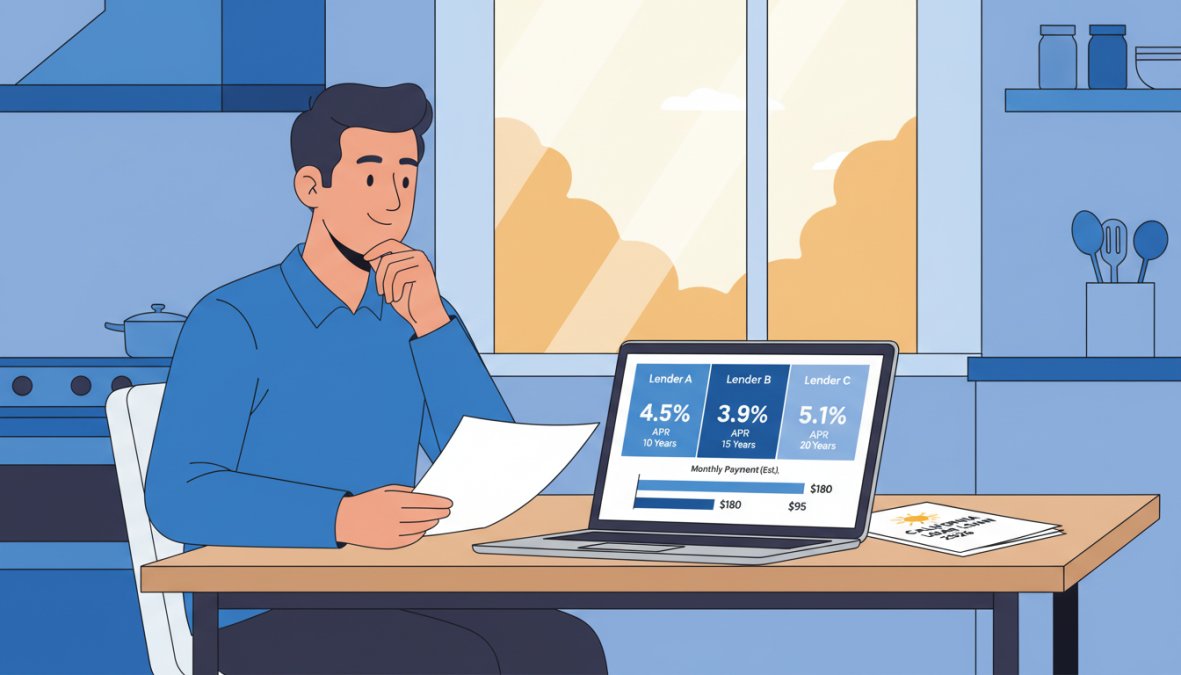
California homeowners have four primary financing structures to choose from, each with a distinct ownership model, cost profile, and long-term implication.
Solar Loans (Secured vs. Unsecured)
A solar loan is a financing arrangement where the homeowner borrows money to purchase a solar system outright, then repays the principal plus interest over a fixed term. Secured solar loans use the home as collateral (similar to a home equity loan), while unsecured loans rely solely on creditworthiness.
Unsecured loans are more common in the residential solar market because they close faster and do not require a home appraisal. The trade-off is a higher APR compared to home equity financing. Secured options, including home equity loans and HELOCs, typically offer lower interest rates but add complexity and closing costs.
Solar Lease and Power Purchase Agreement (PPA)
Under a solar lease or PPA, the homeowner does not own the system. A third party installs and owns the panels, and the homeowner pays either a fixed monthly lease payment or a per-kilowatt-hour rate for the electricity produced.
The appeal is simplicity: no loan, no ownership responsibility, often no upfront cost. The drawback is that the federal Investment Tax Credit (ITC) flows to the system owner, not the homeowner. Over 20-25 years, the cumulative cost of a lease or PPA frequently exceeds the cost of a purchased system. For homeowners who qualify for financing, ownership almost always wins on total cost.
PACE Financing: Property-Assessed Clean Energy
PACE financing is a California-specific product where the loan is repaid through an assessment added to the homeowner’s property tax bill. According to California PACE program guidelines, PACE is available for solar, battery storage, and other qualifying energy efficiency upgrades.
The lien attached to the property is the defining characteristic. PACE debt transfers with the home at sale, which can complicate transactions and title searches. Some mortgage servicers also require PACE assessments to be paid off at closing. Understand the lien implications fully before choosing this route.
Solar Loan vs Cash Purchase Calculator: Which Saves More?
The solar loan vs cash purchase calculator question has a clear answer for most California homeowners: cash wins on total cost, but financing wins on accessibility and immediate cash flow.
Here is the framework to run the comparison yourself:
Total Cost of Ownership (TCO) Formula:
- Cash purchase TCO: System cost – Federal ITC (30%) – State incentives – Lifetime utility savings
- Loan TCO: (Monthly payment x loan term in months) – Federal ITC (30%) – State incentives – Lifetime utility savings + any dealer fees rolled into principal
The critical variable most calculators omit is the dealer fee. If a $25,000 system is financed with a 25% dealer fee rolled in, your actual loan principal is closer to $31,250. Apply your interest rate to that inflated number and the gap between cash and financed total cost widens significantly.
Never compare a loan APR to a cash purchase without first confirming the financed principal. A 5.99% APR on an inflated principal can cost more over 25 years than a 7.5% APR on the true system cost.
The ITC timing also matters. Cash buyers apply the 30% federal tax credit against the actual system cost. Loan borrowers apply it against the same system cost, but if the credit is used to pay down the loan early, the interest savings can partially close the gap with a cash purchase.
How to Qualify for Solar Financing in California
Qualifying for solar financing in California follows a predictable process, but the terms you receive depend heavily on two variables: your FICO score and the lender’s underwriting model. Understanding exactly how lenders tier their rates, and what you can do to move up a tier before applying, is worth more than any negotiation tactic after the fact.
FICO Score Requirements and How Credit Affects Your APR
Most private solar lenders use a tiered pricing model that assigns APR ranges to credit score bands. While exact cutoffs vary by lender and product, the general structure across GoodLeap, Sunlight Financial, and Dividend Finance follows a pattern that California borrowers should understand before applying:
| Credit Score Range | Typical Access Level | What to Expect |
|---|---|---|
| 760 and above | Tier 1 (best rates) | Lowest advertised APR, longest terms available, full product menu |
| 720 – 759 | Tier 2 | Near-best rates, most products available |
| 680 – 719 | Tier 3 | Moderate rates, some products restricted |
| 640 – 679 | Tier 4 | Higher APRs, shorter maximum terms in some cases |
| Below 640 | Limited options | PACE financing or secured products only; most unsecured lenders decline |
The rate gap between Tier 1 and Tier 3 on a 25-year solar loan is not trivial. On a $30,000 financed principal, the difference between a 4.99% APR and a 7.99% APR over 25 years represents thousands of dollars in additional interest paid, often more than the dealer fee borrowers are warned about elsewhere in this guide.
GoGreen’s credit union partners frequently apply more flexible underwriting criteria than private fintech lenders. Credit unions are member-owned institutions with different risk models, and several participating GoGreen lenders offer manual underwriting review for applicants near a tier boundary. This is one reason applying to GoGreen first is worth the extra step even if you have already been pre-approved by a private lender.
How to Improve Your Credit Score Before Applying
If your FICO score is within 20-40 points of a better tier, a focused 3-6 month improvement effort before applying can reduce your total loan cost more than any rate negotiation. The highest-impact actions for most borrowers:
1. Reduce revolving utilization below 30%, ideally below 10%.
Credit utilization (the ratio of your current balances to your total credit limits) is one of the fastest-moving factors in your FICO score. Paying down credit card balances before applying for solar financing can produce a measurable score increase within one to two billing cycles.
2. Dispute any inaccurate derogatory marks.
Request your full credit reports from all three bureaus through AnnualCreditReport.com and review them for errors. Incorrect late payments, duplicate accounts, or accounts that should have aged off can suppress your score. The California Department of Financial Protection and Innovation consumer credit guidance outlines your rights to dispute inaccurate information.
3. Avoid new credit applications in the 90 days before your solar loan application.
Each hard inquiry temporarily reduces your score by a small amount. Multiple inquiries in a short window signal elevated risk to underwriters. If you need to compare lenders, most solar loan applications use a soft pull for pre-qualification, confirm this before authorizing any credit check.
4. Keep existing accounts open.
Closing old credit card accounts reduces your total available credit and shortens your average account age, both of which can lower your score. If you are tempted to close accounts before applying, hold off until after your solar loan closes.
5. Become an authorized user on a long-standing account.
If a family member has a credit card with a long history and low utilization, being added as an authorized user can add positive history to your report. This is a legitimate and commonly used credit-building technique.
Some California credit unions that participate in the GoGreen program offer free credit counseling to members. If your score is below 680, ask the credit union directly whether they provide pre-application guidance, it is a service that private lenders do not offer.
Step-by-Step: How to Apply for a Solar Loan
- Get at least two installer quotes to establish the true system cost, including the cash price and the financed price, before approaching any lender. The gap between those two numbers is your dealer fee.
- Pull your FICO score through your bank, credit card issuer, or a free monitoring service. Note which bureau version is reported, since lenders may pull a different bureau.
- Apply to GoGreen through a participating credit union first. Membership requirements are typically straightforward, and the program carries no lien and no closing costs. Use the GoGreen Home Energy Financing participating lender directory to find an enrolled credit union in your county.
- Request a pre-qualification from at least one private lender (GoodLeap, Sunlight, or Dividend) using a soft pull to compare against your GoGreen offer.
- Ask each lender to disclose the dealer fee or finance fee explicitly and calculate the true financed principal before comparing APRs.
- Confirm prepayment penalty terms before signing, especially relevant if you plan to apply your federal ITC refund as a lump-sum paydown in the first year.
- Review lien terms in the loan agreement before closing. Ask directly: does this loan file a UCC-1? Is there a property tax assessment? (See the Hidden Costs section below for why this matters.)
- Verify your installer’s license through the California Contractors State License Board license lookup before signing any installation contract tied to financing.
Some solar installers present financing paperwork at the end of a sales appointment and encourage same-day signing. You are not required to sign on the day of the appointment. California’s Home Solicitation Sales Act gives you a three-day right to cancel contracts signed at your home. Use that window to review the financed principal, the dealer fee, and the lien terms before committing.
Hidden Costs of Solar Loans: What California Borrowers Miss
Most California homeowners focus on the APR when comparing solar financing. That is the wrong number to anchor on. The true cost of a solar loan is determined by three factors that most guides either underexplain or skip entirely: the dealer fee that inflates your principal before you sign, the UCC-1 lien that can complicate your next refinance or home sale, and, for PACE borrowers, a property tax assessment that transfers with the home regardless of who owns it.
Dealer Fees and How They Inflate Your Principal
A dealer fee (sometimes called a finance fee, platform fee, or origination fee) is a charge the lender collects from the solar installer for access to their financing platform. The installer typically passes this cost to the borrower by inflating the quoted system price. The result: you borrow more than the system actually costs, and you pay interest on the inflated amount for the full loan term.
Dealer fees on private solar loans commonly range from 10% to 30% of the system cost, depending on the lender, the loan term, and the interest rate tier. Longer loan terms and lower interest rates are frequently paired with higher dealer fees, the lender offsets the lower rate revenue by collecting more upfront through the installer. This is why a 0% or 1.99% APR solar loan often has a higher total cost than a 5.99% APR loan on the same system.
Example of how dealer fees change the real comparison:
| Scenario | System Cash Price | Dealer Fee | Financed Principal | APR | 25-Year Total Paid |
|---|---|---|---|---|---|
| Low-rate, high-fee loan | $25,000 | 25% ($6,250) | $31,250 | 1.99% | ~$40,800 |
| Mid-rate, low-fee loan | $25,000 | 10% ($2,500) | $27,500 | 5.99% | ~$53,200 |
| GoGreen credit union loan | $25,000 | None | $25,000 | 4.99% | ~$43,600 |
Note: These figures are illustrative of the structural relationship between dealer fees and total cost. Always request a full amortization schedule from your specific lender before signing.
The fix is simple: ask your installer for the cash price and the financed price as two separate line items before accepting any loan offer. The gap between those two numbers is your effective dealer fee. If an installer refuses to provide the cash price separately, treat that as a significant red flag.
Never compare two solar loan offers using only the monthly payment or the APR. Always compare the financed principal. A lower APR applied to a higher principal can cost more over the loan term than a higher APR on the true system cost.
UCC-1 Lien Implications for Homeowners: The Full Picture
This is the area most solar financing guides in California gloss over, and it is the one that creates the most friction for homeowners at the worst possible time, when they are trying to sell or refinance.
A UCC-1 (Uniform Commercial Code Article 1) financing statement is a legal filing that gives a lender a publicly recorded security interest in personal property used as collateral. Many unsecured solar loans from private lenders file a UCC-1 against the solar equipment, the panels, inverter, and racking, even though the loan is technically unsecured against the real property.
What actually happens when a UCC-1 surfaces during a home sale or refinance:
- Title search discovery. When you list your home for sale or apply for a mortgage refinance, the title company or lender’s underwriter runs a UCC search as part of the title examination. Any active UCC-1 filing against your property or equipment will appear in this search.
- Lender requirements vary. Some mortgage lenders treat a solar UCC-1 as a fixture filing (meaning the equipment is considered part of the real property) and require it to be subordinated or released before they will approve a new mortgage. Others treat it as a personal property lien and allow the loan to remain. There is no uniform standard, which means you may not know how your specific refinance lender will treat it until you are already in the process.
- Subordination requests take time. If your mortgage lender requires the solar lender to subordinate their UCC-1 interest, you must contact the solar lender, request a subordination agreement, and wait for them to process and file it. This can add days to weeks to a closing timeline. In a time-sensitive sale or rate-lock situation, that delay has real financial consequences.
- Payoff complications. If a buyer’s lender requires the UCC-1 to be released entirely before closing, you may need to pay off the remaining solar loan balance at closing, potentially before you planned to. This is not always a problem, but it is a negotiation point that can affect your net proceeds.
GoGreen Home Energy Financing does not require a UCC-1 lien for most loans, which is one of the program’s most underappreciated advantages. If you plan to sell or refinance within the loan term, the absence of a UCC-1 removes an entire category of closing complexity.
PACE Lien: A More Significant Encumbrance
PACE (Property Assessed Clean Energy) financing creates a lien that is categorically different from a UCC-1, and more consequential.
A PACE assessment is recorded as a senior lien on your property, meaning it has priority over your existing mortgage in the event of a default or foreclosure. This is why many conventional mortgage servicers, including those servicing loans backed by Fannie Mae and Freddie Mac, have historically required PACE assessments to be paid in full before they will approve a refinance.
Key PACE lien mechanics California homeowners must understand:
- The lien transfers with the property. If you sell your home with an outstanding PACE balance, the assessment remains attached to the property, not to you personally. The buyer’s lender will typically require the PACE balance to be paid off at closing, which reduces your net sale proceeds.
- It appears on your property tax bill. PACE repayment is collected through your county property tax assessment, which means it is included in your impound/escrow account if your mortgage servicer collects taxes. This can cause your monthly mortgage payment to increase in ways that are not immediately obvious at loan origination.
- Missed payments carry property tax consequences. Because PACE is a property tax assessment, delinquency follows property tax delinquency rules, not consumer loan rules. The consequences of non-payment are more severe than a missed solar loan payment.
According to California PACE program guidelines and consumer protections, California has enacted consumer protection requirements for PACE financing, including mandatory disclosures and a three-day right to cancel. Review those disclosures carefully before signing.
Before signing any solar financing agreement, ask three specific questions: (1) Does this loan file a UCC-1 lien against my equipment or property? (2) Is there a property tax assessment attached to this financing? (3) If I refinance or sell my home before this loan is paid off, what is the process for resolving this lien? The answers to these three questions will tell you more about the real cost and risk of the financing than the APR alone.
The Prepayment Penalty Trap
One additional hidden cost that California borrowers frequently overlook: prepayment penalties on certain solar loan products. Some loan structures, particularly those with very low promotional APRs, include a prepayment penalty or a “dealer fee clawback” provision that activates if the loan is paid off early.
This matters specifically because many California homeowners plan to use their federal Investment Tax Credit (ITC) refund, currently 30% of the system cost, as a lump-sum paydown in the first year. If your loan has a prepayment penalty or requires the full dealer fee to be paid regardless of early payoff, that strategy may cost more than expected.
GoGreen and Dividend’s EmpowerLoan both explicitly carry no prepayment penalties. For any other product, confirm the prepayment terms in writing before signing.

NEM 3.0 Impact: How California Solar Policy Changes Your Loan ROI
California’s Net Energy Metering 3.0 (NEM 3.0) policy, which took effect for new interconnection applications in April 2023, fundamentally changed the economics of residential solar in the state.
Under NEM 3.0, the export rate for surplus solar electricity sent to the grid dropped significantly compared to NEM 2.0. Homeowners who relied on grid export credits to offset their utility bills now see smaller credits, which extends the payback period for solar-only systems. According to California Public Utilities Commission NEM 3.0 decision documentation, the new export rates are designed to incentivize on-site consumption and battery storage over grid export.
The direct implication for loan ROI: a solar-only system financed under NEM 3.0 takes longer to break even than the same system would have under NEM 2.0. The loan payments remain fixed, but the utility bill savings are lower in the early years because export credits are smaller.
The counter-strategy is battery storage. A solar plus battery storage system under NEM 3.0 can store surplus generation for evening use rather than exporting it at reduced rates. This improves self-consumption, increases utility bill savings, and restores much of the ROI that NEM 3.0 eroded for solar-only systems. GoodLeap and Dividend Finance both offer loan products that cover combined solar and battery storage systems under a single financing agreement.
If you are comparing solar financing options in 2026, any ROI projection that does not account for NEM 3.0 export rates is using outdated assumptions. Ask your installer for a production estimate that models self-consumption under NEM 3.0, not just total generation.
Compare Solar Loan Options: Pros, Cons, and Best Fit by Situation
The right financing option depends on your credit profile, how long you plan to stay in the home, and whether you want battery storage.
| Financing Type | Pros | Cons | Best Fit |
|---|---|---|---|
| GoGreen Credit Union Loan | Lowest rates, no lien, no closing costs | Requires credit union membership | Most California homeowners |
| GoodLeap | Flexible terms, covers battery storage | Dealer fees inflate principal | Homeowners wanting 25-year terms |
| Sunlight Financial | Fast approval, wide contractor network | Dealer fees, less transparent pricing | Contractor-driven purchases |
| Dividend EmpowerLoan | No prepayment penalty, same-day funding | PACE option carries property lien | Homeowners wanting fast closing |
| PACE Financing | No credit check required in some cases | Property lien, complicates home sale | Homeowners with limited credit options |
| Cash Purchase | Lowest total cost, no lien | Requires significant upfront capital | Homeowners with available capital |
| Solar Lease / PPA | No upfront cost, no ownership risk | No ITC benefit, higher lifetime cost | Renters or those with poor credit |
A common mistake is choosing the fastest approval rather than the best terms. Sunlight Financial’s instant Orange Portal approval is genuinely convenient, but convenience is not a financial strategy. Take the extra week to apply to GoGreen and compare the total financed cost before committing.
For Bakersfield and Kern County homeowners specifically, Discount Solar works with multiple financing partners and can walk you through the true cost comparison across options, including the GoGreen program, before you sign anything.
If you are considering a loan with a term longer than 15 years, calculate the total interest paid over the full term, not just the monthly payment. A lower monthly payment on a 25-year loan can cost significantly more in total interest than a higher payment on a 12-year loan.
Choosing the right solar financing is genuinely complicated by the number of options, the opacity of dealer fees, and the policy changes introduced by NEM 3.0. Discount Solar has guided Kern County homeowners through this decision for over a decade, offering custom solar solutions backed by a 25-year equipment warranty and a team of certified installers who know the local grid, local incentives, and local lenders. Get your estimate from Discount Solar and see exactly what your system will cost, what it will save, and which financing structure makes the most sense for your situation.
Frequently Asked Questions
What are the current solar loan interest rates in California for 2026?
When you compare solar loan interest rates in California, rates generally range from around 2.99% APR through state-supported programs like GoGreen Home Energy Financing up to roughly 9% APR through private lenders like GoodLeap. Your actual rate depends on your FICO score, loan term, lender type, and whether dealer fees are factored into the principal. Credit unions participating in CAEATFA-backed programs tend to offer the most competitive fixed interest rates for qualified borrowers.
Is it better to lease solar panels or get a solar loan in California?
A solar loan typically delivers better long-term ROI than a lease or PPA because you own the system and can claim the federal tax credit. With a lease or PPA, the third-party owner retains the tax benefits. However, leases require no down payment and no credit approval, making them accessible for homeowners who don’t qualify for financing. If your FICO score supports a competitive APR, a solar loan almost always results in greater utility bill savings over the system’s lifetime.
Do solar loans affect your credit score?
Yes, applying for a solar loan triggers a hard credit inquiry, which can temporarily lower your FICO score by a few points. Once the loan is active, your score is affected by your payment history and how the new debt impacts your credit utilization. Making on-time monthly payments generally improves your credit over the loan term. Unsecured solar loans have less impact on your property title than PACE financing, which places a lien on your home and can affect your ability to sell or refinance.
What hidden costs should I watch for in solar loans?
The most common hidden costs of solar loans include dealer fees, which lenders charge installers and which are often rolled into your loan principal, effectively raising your APR beyond the advertised rate. Watch also for prepayment penalties, deferred interest clauses, and UCC-1 lien filings on unsecured loans that can complicate a home sale. Some lenders also charge origination or closing costs. Always request a full loan disclosure and compare the total cost of ownership, not just the monthly payment, before signing.
Are there government-backed solar loan programs in California?
Yes. The GoGreen Home Energy Financing Program, backed by CAEATFA (California Alternative Energy and Advanced Transportation Financing Authority), partners with participating credit unions to offer low-interest loans for solar and battery storage projects. Loans can reach up to $75,000 with rates starting as low as 2.99% APR, no closing costs, and no prepayment penalties. Eligibility requires membership in a participating credit union, and additional rate discounts may apply for automatic payments or low-income community status.
How does NEM 3.0 affect the ROI of a solar loan in California?
California’s NEM 3.0 policy significantly reduced the export credit rate utilities pay for excess solar energy sent to the grid, lowering the financial return for grid-tied systems without battery storage. This means solar loan ROI calculations made under older NEM 2.0 assumptions may be overstated. Pairing solar panels with a battery storage system helps maximize self-consumption and offset the reduced export credits. When comparing solar loan interest rates in California, factor NEM 3.0 into your payback period estimate to get an accurate picture of total savings.